Brain–computer interface (BCI) is the general term for a system that measures activity in the nervous system, extracts a variable of interest from that activity, and turns it into a command for a computer, a prosthesis, or the person's own muscles. The defining feature, in the standard formulation, is that the command bypasses the ordinary output path of peripheral nerve and muscle.1 A BCI is therefore useful mainly to people whose ordinary output path is broken, and as of 2026 every serious clinical result comes from that population: participants with tetraplegia, brainstem stroke, or amyotrophic lateral sclerosis.
The field has produced genuinely striking demonstrations — a person with no usable movement controlling a robotic arm, another producing fluent synthesized speech from motor-cortex activity alone — in a very small number of research participants, using hardware that is tethered, requires frequent recalibration, and has not been approved by any regulator for permanent use. The gap between those demonstrations and a product is largely a gap in reliability, longevity, and manufacturing, not in principle.
The signal chain
Every BCI is the same four stages: acquisition, feature extraction, decoding, and output, usually with a feedback loop closing back to the user.
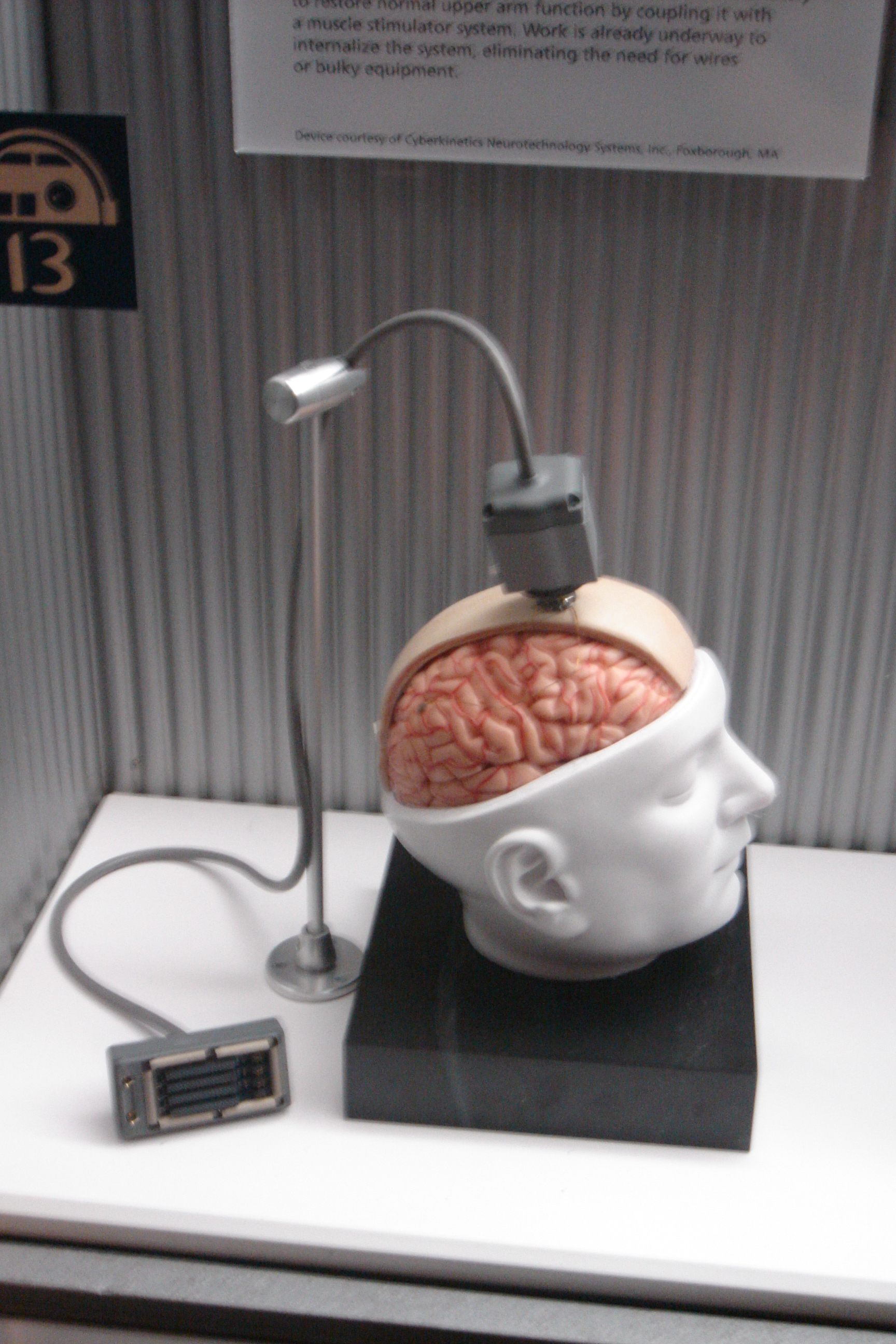
Acquisition determines everything downstream. Signals differ by how close the sensor sits to the neurons producing them. Penetrating microelectrodes recording action potentials from individual cells carry the most information per channel; scalp electroencephalography, separated from cortex by dura, skull, and scalp, carries the least, because the skull acts as a spatial low-pass filter that smears contributions from many square centimetres of cortex into one measurement.
Feature extraction reduces raw voltage into something a decoder can use: firing rates binned over tens of milliseconds, power in a frequency band, the amplitude of an evoked potential. In cortical recordings the workhorse features are threshold crossings and high-gamma power (roughly 70–200 Hz), the latter being a reasonable proxy for local population spiking that can be measured without penetrating the cortex.
Decoding maps features to intent. Early systems used linear filters and the population-vector approach inherited from primate motor physiology; current systems use Kalman filters, recurrent neural networks, and increasingly transformer-style sequence models paired with language models. Neural decoding is where most of the recent performance gains have come from — the electrodes in the best 2025 speech systems are not fundamentally better than those used in 2012.
Output is a cursor, a robotic arm, a synthesized voice, a wheelchair, or stimulation delivered to the user's own spinal cord or to a powered Powered exoskeletons. Bidirectional systems also write information back in, which is a much harder problem than reading it out and remains the main limitation for restoring touch.
Non-invasive systems
Scalp EEG supports three well-characterized paradigms. The P300 speller flashes rows and columns of a character grid and detects the evoked response that follows an attended flash; steady-state visually evoked potential systems tag each option with a distinct flicker frequency and read off which frequency dominates visual cortex; sensorimotor-rhythm systems ask the user to imagine movement of a limb and detect the resulting suppression of mu and beta rhythms. All three work. None is fast: information transfer rates are conventionally reported in the range of tens of bits per minute, on the order of a few characters, against several hundred bits per minute for competent typing.
Functional near-infrared spectroscopy and functional MRI measure haemodynamics rather than electrical activity, and are therefore limited by the seconds-long delay of the blood-oxygen response. fMRI remains valuable for decoding research precisely because it covers the whole brain, but a scanner is not a wearable device. Consumer EEG headsets sit at the weakest end of the spectrum, typically with a handful of dry electrodes and heavy artefact contamination from eye movement and jaw muscle.
| Dimension | Penetrating microelectrodes | Subdural ECoG | Endovascular | Scalp EEG |
|---|---|---|---|---|
| Surgery | Craniotomy, cortical penetration | Craniotomy or slot | Catheter via jugular vein | None |
| Resolution | Single neurons | Millimetre populations | Coarse populations | Centimetre populations |
| Typical channels | 96–1,024 | 64–1,024 | 16 | 8–256 |
| Long-term stability | Degrades over months to years | Good over years | Good over years | Good, but user-dependent |
| Demonstrated ceiling | Multi-degree-of-freedom limb control, fluent speech | Fluent speech, walking via spinal stimulation | Discrete clicks | Spellers, simple switches |
Development history
The name is older than the capability. Jacques Vidal proposed in 1973 that a computer could interpret electroencephalographic signals in real time as deliberate control commands, coining the phrase and sketching the architecture two decades before hardware could support it.2 Animal work in the late 1990s established that ensembles of cortical neurons carry enough movement information to drive a machine; the human trials followed within five years.
-
1924Human EEG recordedHans Berger records electrical rhythms from the human scalp, establishing that cortical activity can be measured non-invasively.
-
1973The term is coinedJacques Vidal at UCLA publishes 'Toward direct brain-computer communication', proposing that computers could interpret EEG in real time as control signals.
-
1999–2002Motor decoding in animalsGroups led by John Chapin, Miguel Nicolelis, and Andrew Schwartz show that rats and monkeys can control levers and robotic arms using decoded cortical ensemble activity.
-
2004–2006First long-term human implantMatthew Nagle, paralysed by a spinal cord injury, receives a Utah array in the BrainGate pilot and controls a cursor, a television, and a prosthetic hand.
-
2012–2013Robotic arm controlBrainGate and University of Pittsburgh teams report multi-degree-of-freedom robotic arm control by participants with tetraplegia, including self-feeding.
-
2016Fully implanted communication BCIA Utrecht group implants a wireless electrocorticography system in a person with late-stage ALS, who uses it at home for years to select letters.
-
2021–2024Speech decoding becomes fluentUCSF, Stanford, and UC Davis teams decode attempted speech at conversational rates from motor cortex, with large vocabularies and single-digit word error rates in the best case.
-
2023Brain–spine interfaceA Lausanne team restores volitional walking in a man with spinal cord injury by linking a cortical implant to an epidural spinal stimulator.
-
2024–2026Commercial implants enter trialsNeuralink, Synchron, Precision Neuroscience, Paradromics, and several Chinese groups run early feasibility studies; none has regulatory approval for routine use.
Current state
Three capability areas have credible human results.
Cursor and device control. People with tetraplegia can move a computer pointer, click, type on a virtual keyboard, and drive a robotic arm through several degrees of freedom.3 The 2012 and 2013 robotic-arm reports, in which participants reached, grasped, and drank unassisted, remain the reference demonstrations.45 Performance in the best participants approaches a slow but usable pointing device. The Utah array remains the most common sensor for this work, and the multi-site BrainGate consortium has produced most of the long-run data. A fully implanted surface-electrode system used at home by a person with late-stage ALS demonstrated that the approach can survive outside a laboratory.6
Speech. Between 2021 and 2025 decoding of attempted speech moved from a 50-word vocabulary at around fifteen words per minute to conversational-rate output over vocabularies of more than a hundred thousand words, with the best reported word error rates in the single digits for one participant. Some systems now synthesize a voice reconstructed from pre-illness recordings, or animate an avatar. See Speech neuroprosthesis.
Movement restoration. Rather than driving an external robot, a cortical implant can drive stimulation of the user's own spinal cord or muscles, re-establishing a "digital bridge" around a lesion. This has been demonstrated for grasping and, in a 2023 report, for volitional walking in a man with an incomplete spinal cord injury, who retained some improvement even with the system switched off.7
Device approaches now in human trials span the invasiveness spectrum: penetrating arrays (Neuralink, Paradromics, Blackrock Neurotech), thin-film surface arrays (Electrocorticography interfaces, Precision Neuroscience), and endovascular electrodes threaded through a vein (Stentrode, developed by Synchron). Each trades bandwidth against surgical risk. Several Chinese academic and state-backed groups have also reported implants in participants since 2024, though public detail is limited and independent verification scarce.
What has not been demonstrated is equally worth stating. No BCI has restored a rich sense of touch; the best feedback so far is a small number of discriminable pressure percepts delivered by intracortical or peripheral stimulation, well short of what a hand needs. No system has restored memory in a clinically meaningful way, despite the encoding-model work described under Memory prosthesis. And no implanted BCI has been shown to improve any capability in a healthy person, which is the premise on which most enhancement-oriented interest rests.
Sample sizes are tinyThe headline results in this field typically come from one to four participants, often the same individuals across multiple papers, with hardware maintained by a research team. Nothing here has been tested at the scale that would establish reliability, and single-participant results have repeatedly failed to generalize.
The bandwidth problem
Popular framing treats BCI progress as an electrode-count race, on the assumption that information transfer scales with channels. It does not scale cleanly. Motor cortical activity during reaching is well described by a low-dimensional dynamical structure — a neural manifold — in which a few dozen latent dimensions capture most of the variance.8 Adding electrodes samples that same structure more densely rather than revealing new independent signals, so returns diminish. This is why a 96-channel array from the 1990s can support performance comparable to systems with ten times the channels, and why decoder architecture has mattered more than sensor count.
Where more channels do help is coverage: sampling several cortical areas, or sampling a functional map finely enough to separate articulators in speech cortex. The genuinely hard constraints are elsewhere — the number of independent control dimensions a person can learn to modulate, the non-stationarity of the recorded population from day to day, and the near-total absence of a high-resolution write channel. Reading intention out is a solved-enough problem for many applications; writing rich sensory information in is not, which is why touch feedback in Neuroprosthetics remains crude compared with motor decoding.
Limitations
Implanted arrays lose channels. The brain mounts a foreign-body response — microglial activation, astrocytic encapsulation — that displaces neurons from the recording tip, while insulation and metal traces degrade in a warm saline environment. Signal yield typically declines over months to years, though some implants have supported usable control beyond a thousand days and a few for several years; the failure statistics are set out under Utah array.
Percutaneous connectors, still standard in academic systems, carry infection risk and tether the user to a lab. Fully implanted wireless systems solve this but constrain power and data rate; the most aggressive proposal for removing the tether, untethered ultrasonic motes, is covered under Neural dust and ultrasonic implants and has no human results. Decoders drift, requiring recalibration that ranges from minutes daily to occasional, depending on the system. Almost all reported performance comes from controlled settings with a technician present.
There is also a structural risk specific to commercial neurotechnology: a company can fail while its devices remain in people's heads. The discontinuation of the Argus II retinal system left users with unsupported implants, a precedent that shadows every BCI trial. See Retinal implants and visual prostheses.
Ethics and governance
Implanted BCIs raise questions that older neurotechnology such as Deep brain stimulation and the Cochlear implant introduced in milder form: who owns the neural data, what happens when a decoder misreads intent, and whether a device that shapes behaviour compromises agency. The specific novelty is that recorded activity can support inferences the user did not intend to disclose, an issue taken up under Mental privacy. Legislatures have begun responding — constitutional and state-level neural-data provisions exist in several jurisdictions — under the banner of Neurorights, though enforcement mechanisms remain thin.
Consumer neurotechnology is a separate regulatory category and a much weaker technical one. Wearable EEG headsets and Non-invasive neuromodulation devices are sold for attention training, sleep, and gaming with evidence that ranges from thin to absent, and the "brain-reading" claims attached to them substantially outrun what scalp electrodes can resolve. Regulators have generally treated these as wellness products rather than medical devices, the same line that governs Wearable health sensors, which is why the emerging neural-data statutes target data handling rather than efficacy claims.
How invasive is worth itSynchron's position is that a device delivered by catheter, with sixteen electrodes, will reach far more patients than one requiring a craniotomy, and that discrete reliable control is enough for most assistive tasks. The counter-position, taken by the penetrating-array developers, is that low-bandwidth control caps the addressable applications at switch-like interaction and rules out speech and dexterous limb control. Both claims are testable and neither has been settled.
Outlook
The near-term agenda is legible: more participants, wireless and fully implanted systems, decoders intended to survive a week without recalibration, and eventually a pivotal trial in a well-defined indication such as loss of speech in ALS. If that sequence holds, it could produce an approved assistive device for a small clinical population, though no timeline for it is well supported and none of the current studies is large enough to predict one.
The longer-term claims — that BCIs will serve as a general-purpose channel for Human–AI merger, or provide the read-out fidelity that Whole brain emulation would require — rest on assumptions the clinical work does not test. A speech decoder recovers a motor plan, not a thought; a 1,024-channel array samples a millionth of a cortical hemisphere. Whether elective implantation in healthy people ever clears the risk-benefit bar is a question about surgical complication rates and device lifetimes, and neither is currently known well enough to answer.
See also
- Neural decoding
- Utah array
- Stentrode
- Speech neuroprosthesis
- Neuroprosthetics
- Neuralink
- Brain-to-brain interfaces
- Neurorights
References
Footnotes
-
paperWolpaw, J. R. et al. "Brain–computer interfaces for communication and control." Clinical Neurophysiology, 2002. ↩
-
paperVidal, J. J. "Toward direct brain-computer communication." Annual Review of Biophysics and Bioengineering, 1973. ↩
-
paperHochberg, L. R. et al. "Neuronal ensemble control of prosthetic devices by a human with tetraplegia." Nature, 2006. ↩
-
paperHochberg, L. R. et al. "Reach and grasp by people with tetraplegia using a neurally controlled robotic arm." Nature, 2012. ↩
-
paperCollinger, J. L. et al. "High-performance neuroprosthetic control by an individual with tetraplegia." The Lancet, 2013.↩A single participant, whose performance was reached over months of training with the research team present.
-
paperVansteensel, M. J. et al. "Fully implanted brain–computer interface in a locked-in patient with ALS." New England Journal of Medicine, 2016. ↩
-
paperLorach, H. et al. "Walking naturally after spinal cord injury using a brain–spine interface." Nature, 2023. ↩
-
paperGallego, J. A. et al. "Neural manifolds for the control of movement." Neuron, 2017.↩A perspective drawn largely from animal motor cortex; the inference that added electrodes give diminishing returns is an extrapolation from it.