Powered exoskeletons are wearable machines whose structure runs alongside the body's own skeleton and whose actuators apply torques across the wearer's joints. They are used clinically to move the legs of people with paralysis, industrially to offload weight from a worker's back and shoulders, and militarily — mostly in prototype — to carry loads. The engineering problem is deceptively hard, because an exoskeleton must produce more benefit than the metabolic and mechanical cost of carrying it. Unlike the implanted devices grouped under Neuroprosthetics, or the skeletal anchorage described in Osseointegration, an exoskeleton touches the body only at straps and cuffs, which is both its principal safety advantage and the source of most of its engineering difficulty.
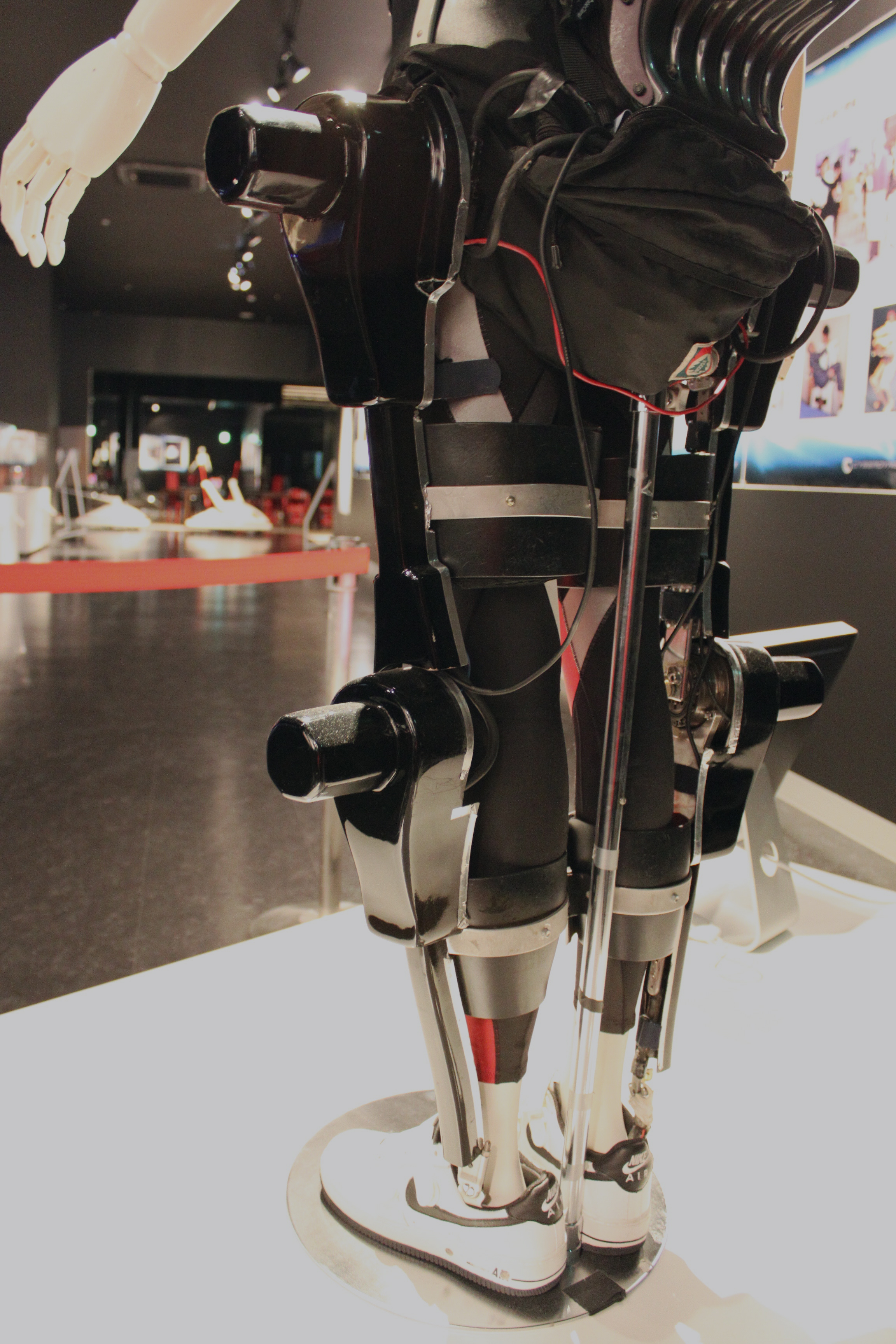
How they work
Three subsystems define a device. The structure transmits load, ideally into the ground rather than into the wearer, and must keep its joints aligned with human joints that are not simple hinges; misalignment produces shear at the attachment points and is a common source of discomfort and abandonment. The actuators supply torque, most often through electric motors with harmonic or ball-screw transmissions, sometimes hydraulically for high force, and sometimes not at all in passive designs that store energy in springs. The controller decides when and how much to assist.
Intent detection is the control problem. Options range from simple state machines triggered by weight shift and joint angle, through force sensors in the shoe, to surface electromyography that reads the wearer's muscle activity before movement begins — the approach taken by Japan's HAL system, which uses skin-surface bioelectrical signals as its control input and shares its signal chain with Myoelectric prosthetics. Cortical control through a Brain–computer interface has been demonstrated in single participants and adds surgical risk to a problem that peripheral sensors mostly solve; the same intent-estimation methods used in Neural decoding apply, but the signal is easier to obtain at the muscle.
The distinction between rehabilitation devices, which move a limb the wearer cannot move, and augmentation devices, which assist a limb the wearer can move, matters more than the hardware suggests. The first must be safe when the wearer contributes nothing; the second must interfere with nothing when the wearer needs no help, a much harder requirement, because an actuator that fights the user is worse than no actuator at all.
Development history
-
1965–1971HardimanGeneral Electric builds a full-body hydraulic master-slave suit weighing around 680 kg. Only one arm is ever operated, and it moves violently enough to be considered unsafe with a person inside.
-
Late 1960sActive exoskeletons in BelgradeMiomir Vukobratović's group at the Mihajlo Pupin Institute builds legged exoskeletons for rehabilitating paraplegic patients, developing the zero-moment-point criterion that later underpins bipedal robotics.
-
2000–2008DARPA funding and BLEEXA US programme on exoskeletons for human performance augmentation funds the Berkeley Lower Extremity Exoskeleton and spawns Ekso Bionics and Lockheed's HULC.
-
2011–2016Clinical clearancesMedical exoskeletons for spinal cord injury and stroke gain regulatory clearance in Japan, Europe, and the United States; the first personal-use clearance in the US comes in 2014.
-
2015–2022Soft suits and optimized assistanceTextile-based exosuits and human-in-the-loop optimization of assistance profiles produce the largest measured reductions in the metabolic cost of walking.
-
2019–2025Military programmes retrenchThe US special operations powered-armour programme ends without a fielded suit, and several full-body industrial exoskeleton efforts are scaled back, while passive industrial exosuits find a durable market.
Evidence in rehabilitation
Overground exoskeletons let many people with complete or incomplete spinal cord injury stand and walk in a supervised setting, and the devices are safe in trained hands. What is not established is that they produce better functional outcomes than conventional gait training. Systematic reviews of exoskeleton-assisted walking after spinal cord injury and stroke repeatedly conclude that the evidence base is small, heterogeneous, and insufficient to demonstrate superiority; secondary benefits often claimed — bowel function, spasticity, bone density, cardiovascular fitness — are supported mainly by small studies and self-report.
Practical constraints compound this. Walking speeds achieved with lower-limb exoskeletons are typically far below what is needed for community ambulation, nearly all devices require forearm crutches and therefore intact upper-limb function, donning takes minutes and often requires assistance, and users cannot navigate the stairs, kerbs, and uneven ground that make up ordinary environments. For most people with paraplegia a wheelchair remains faster, cheaper, and more reliable, which is not a failure of the technology so much as a statement of the standard it has to beat. Disability advocates have also questioned the emphasis on restoring upright walking over improving wheelchair access, an argument set out under Disability rights and enhancement. Implanted alternatives that stimulate the user's own spinal circuitry attack the same problem from inside the body, and epidural stimulation trials have produced volitional stepping in participants who could not achieve it in a powered frame.
Where exoskeletons appear more clearly useful is as therapy delivery: a device that lets one therapist provide high-repetition, high-dose gait practice instead of two or three therapists manually moving a patient's legs. That is a labour-productivity argument rather than a functional one.
Soft exosuits are the most promising rehabilitation variant. A textile suit applying modest assistance to ankle plantarflexion and hip flexion improved walking symmetry and reduced metabolic cost in people with post-stroke hemiparesis.1 They are lighter, do not require joint alignment, and cannot lock a limb, which reduces the safety burden.
Industrial and military use
Industrial exoskeletons have quietly become the largest deployed category, and most are passive. Spring-loaded shoulder supports for overhead work and back supports that store energy during forward bending reduce measured muscle activity in the assisted region, which is well established. Whether they reduce injury rates over years is not, and there is a recognized concern that load removed from one joint reappears at another — a back support can increase demand on the hips or alter gait. Long-term field trials are scarce.
Military programmes have a consistent record of ambition followed by retrenchment. The US special operations "tactical assault light operator suit" effort was terminated in 2019 without producing a fielded system, and several powered load-carriage exoskeletons have been discontinued. The recurring failure is not strength but endurance: a soldier's mission profile demands hours of untethered operation, and no battery chemistry supplies that at acceptable weight. Lighter, narrower-purpose devices such as powered knee assists for load carriage have fared better.
The military case also raises the coordination problem examined under Enhancement arms race: capabilities adopted because an adversary might adopt them, with no individual actor able to stop unilaterally. Unlike pharmacological or genetic augmentation, an exoskeleton is removable, which makes it the least ethically fraught form of Human enhancement and, for the same reason, the one likely to be normalized first. Competitive sport has already banned assistive devices outright rather than attempting to regulate their degree, a simpler line than the one drawn for prosthetic athletes under Enhancement in sport.
Space agencies are a distinct customer. Crews returning from long missions lose bone and muscle at rates described under Space medicine, and exoskeletons have been proposed both as inflight resistive-exercise devices and as ground-support equipment during readaptation; the countermeasure problem in Microgravity adaptation remains dominated by conventional exercise hardware.
The power and actuator problem
The physics is unforgiving. An exoskeleton that assists walking must overcome the metabolic penalty of its own mass, and mass carried distally — at the ankle or foot — costs several times more than mass at the waist. Electric motors have high power density but low torque density, so they need gearboxes, which add mass, friction, and backdrive resistance. Hydraulics deliver torque but need a pump, fluid, and heat rejection. Batteries are the hard ceiling: lithium-ion cells store on the order of a few hundred watt-hours per kilogram, well over an order of magnitude below liquid fuel, so untethered full-body augmentation trades run time against weight in a loop that has no good solution.
This is why the strongest results come from minimal devices. An entirely unpowered ankle exoskeleton using a spring and a mechanical clutch reduced the metabolic cost of walking by roughly seven percent, with no battery at all.2 Portable powered ankle exoskeletons whose assistance profile is optimized to the individual wearer through iterative real-world testing have produced reductions on the order of fifteen to twenty percent, along with increased walking speed.3 Both results concern healthy walking on flat ground, and neither approaches the popular image of powered armour.
Assistance has to be personalizedThe largest metabolic gains come not from stronger actuators but from tuning the timing and shape of assistance to the individual, discovered automatically by measuring the wearer's energy use across many candidate profiles. A generic assistance pattern can make walking harder rather than easier.
Outlook
Three trajectories are plausible and largely independent. Passive and lightly powered industrial exosuits could keep spreading on economics alone, since their case does not depend on any advance in actuators or batteries. Medical exoskeletons are likely to stay a rehabilitation-clinic technology unless payers accept them for personal use at scale, a process that has begun in some health systems but proceeds slowly and unevenly, with the access pattern described in Access and inequality.
The demographic argument is the most consequential and least discussed. Age-related loss of muscle mass and power is the mechanism behind most mobility loss in old age, and no drug reliably reverses it; the best evidence remains for training itself, discussed under Exercise as a geroprotector, and mobility is one of the functional domains any serious measure of Healthspan has to capture. A light, cheap, comfortable hip or ankle assist that lets an eighty-year-old keep walking would affect far more people than any spinal cord injury device, and it is a much easier engineering target than powered armour. Whether such a device can be made unobtrusive enough that people will actually wear it is a design question, not a physics one, and it is where the field's near-term value most likely lies.
See also
- Myoelectric prosthetics
- Osseointegration
- Neuroprosthetics
- Human enhancement
- Enhancement in sport
- Disability rights and enhancement
- Exercise as a geroprotector
- Brain–computer interface
References
Footnotes
-
paperAwad, L. N. et al. "A soft robotic exosuit improves walking in patients after stroke." Science Translational Medicine, 2017.↩A small study of ambulatory stroke survivors measuring the immediate effect of assistance, not the outcome of a training programme.
-
paperCollins, S. H., Wiggin, M. B., Sawicki, G. S. "Reducing the energy cost of human walking using an unpowered exoskeleton." Nature, 2015.↩The saving is in healthy adults walking on level ground in a laboratory, and says nothing about impaired gait.
-
paperSlade, P., Kochenderfer, M. J., Delp, S. L., Collins, S. H. "Personalizing exoskeleton assistance while walking in the real world." Nature, 2022. ↩