Cochlear implants are surgically implanted devices that restore a usable sense of hearing by delivering electrical pulses directly to the auditory nerve, replacing the function of the inner ear's hair cells rather than amplifying sound as a hearing aid does. They are the most widely deployed neuroprosthesis in existence and the only one that routinely restores a lost sense well enough for most adult recipients to hold a conversation. They are also the subject of the oldest live ethical dispute in Neuroprosthetics, because a substantial part of the Deaf community regards deafness as a linguistic identity rather than a deficit to be corrected.
How it works
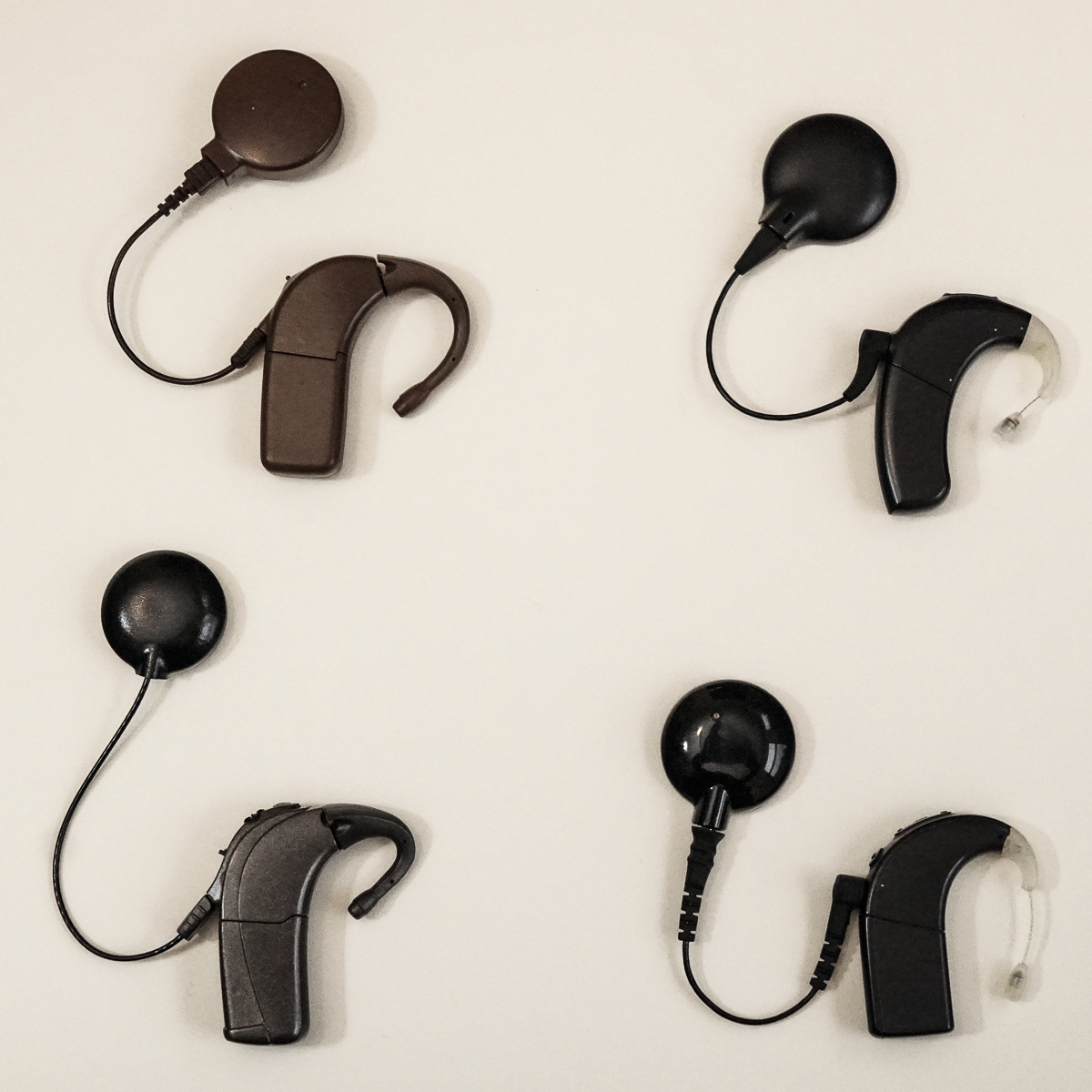
Sound reaches a microphone on a behind-the-ear or off-the-ear processor. The processor splits the signal into a bank of frequency channels, extracts the slowly varying amplitude envelope of each, and converts those envelopes into a schedule of biphasic current pulses. The schedule is transmitted through the intact skin by radio-frequency coupling across a magnetically aligned coil pair to a receiver-stimulator seated in a recess milled into the temporal bone. From there a wire bundle runs to an electrode array threaded through the round window into the scala tympani, roughly one to one-and-a-half turns along the cochlear spiral.
The array exploits tonotopy. The cochlear base responds to high frequencies and the apex to low ones, so an electrode's position determines the pitch a stimulated population of spiral ganglion neurons signals. High-frequency channels drive basal electrodes, low-frequency channels drive apical ones, and the auditory system interprets the result as sound with approximately correct spectral structure.
The decisive engineering insight was interleaving. Because current spreads through conductive perilymph, simultaneous stimulation on neighbouring electrodes sums unpredictably. Continuous interleaved sampling, introduced in 1991, fires only one electrode at a time in rapid rotation, which sharply reduced channel interaction and produced a step change in speech scores.1 Most modern strategies are refinements of that idea, often selecting only the few highest-energy channels in each cycle.
What the encoding discards is temporal fine structure — the rapid waveform detail within each frequency band that carries pitch, timbre, and much of the information used to separate one talker from another. A cochlear implant transmits envelope, not waveform. This single design choice explains most of the device's characteristic failures.
The device is an encoder, not a decoder: it writes information into the nervous system rather than reading intent out of it, which puts it on the harder side of the asymmetry described under Brain–computer interface and Neural decoding research. Its success despite that is the strongest existing evidence that a crude artificial code can be learned by a sensory system given enough exposure.
Development history
-
1957First direct auditory nerve stimulationAndré Djourno and Charles Eyriès stimulate the auditory nerve of a deaf patient in Paris, who perceives crude sound sensations.
-
1961–1972Single-channel devicesWilliam House in Los Angeles implants single-electrode devices and, with the 3M company, brings a wearable version to patients; most researchers doubt that useful speech understanding is achievable.
-
1977–1978Multichannel implantsIngeborg and Erwin Hochmair in Vienna and Graeme Clark's group in Melbourne implant multi-electrode arrays; Clark's first recipient, Rod Saunders, demonstrates speech perception.
-
1984–1985Regulatory approvalThe US Food and Drug Administration approves a single-channel device for adults, followed by the multichannel Nucleus system.
-
1990Children approvedUS approval extends to children aged two and over, shifting the field toward early implantation and provoking organized objection from Deaf associations.
-
1991Continuous interleaved samplingBlake Wilson and colleagues publish a non-simultaneous stimulation strategy that substantially improves open-set speech recognition.
-
2000sBilateral and hybrid devicesBilateral implantation becomes common, and electric-acoustic 'hybrid' devices preserve residual low-frequency hearing in the implanted ear.
-
2020sAge limits fall furtherApproved implantation ages drop below one year for some devices, and gene therapies for specific genetic deafness enter first-in-human trials.
Outcomes
Postlingually deafened adults — people who lost hearing after acquiring spoken language — do best. Most reach open-set sentence recognition in quiet, meaning they can understand speech without lipreading or a closed set of choices, and many use the telephone. Group averages conceal enormous variance: outcomes range from near-normal scores to little more than sound awareness, and the established predictors (duration of deafness, aetiology, surviving neural population, age, cognition) together explain only part of the spread. Predicting an individual's result before surgery remains unreliable.
In children, timing dominates. A prospective multicentre US cohort found that children implanted earlier gained spoken language faster than those implanted later, with the youngest group closest to the trajectory of hearing peers.2 Congenital deafness leaves auditory cortex without patterned input during a developmental window, and implantation after that window produces poorer speech perception. This is the empirical basis for the push toward infant implantation, and the reason the ethical dispute cannot be deferred to the child's own later decision.
Bilateral implantation improves sound localization and gives a modest advantage for speech in noise. It does not restore normal binaural hearing, because the two processors are not synchronized at the level of temporal fine structure.
Limitations
The functional ceiling is spectral. Adding physical electrodes does not add independent channels past a point, because current from one contact excites neurons near its neighbours. Experiments with acoustic simulations in normal-hearing listeners and with electrode-deactivation in implant users converge on roughly eight effective channels for most recipients — enough for speech in quiet, which is highly redundant, and not enough for the tasks that require spectral detail.3 The same saturation limits the Retinal implants and visual prostheses, for the same physical reason.
The consequences are consistent across recipients:
- Speech in background noise degrades much faster than in normal hearing.
- Music is generally reported as thin or unpleasant; melody recognition without rhythmic cues is poor, though many users retain rhythm perception.
- Talker identity, prosody, and tonal-language lexical tone are carried largely by fine structure and transmit poorly.
Surgical risk is low but real: facial nerve injury, vestibular disturbance, loss of any residual acoustic hearing in the implanted ear, and device failure requiring reimplantation. Recipients carry an elevated risk of bacterial meningitis, identified in the early 2000s and associated particularly with one discontinued electrode design; pneumococcal vaccination is standard practice. Devices constrain magnetic resonance imaging, a limitation shared with Deep brain stimulation hardware, though newer receiver magnets are designed for compatibility.
Cost and access are the larger practical limits. Device, surgery, and the years of audiological programming and rehabilitation that follow run to tens of thousands of dollars, and the great majority of implants are performed in high-income countries. The distribution problem that Access and inequality describes for expensive medicine generally is visible here in an unusually stark form: the technology is mature, and most of the world's profoundly deaf people still do not receive it.
The Deaf community objection
The National Association of the Deaf issued a position paper in 1991 opposing routine paediatric implantation, and revised it in 2000 into a more accommodating statement that nonetheless insists on sign language access and on Deaf people's role in decisions about deaf children.4 The core argument is not that implants fail. It is that deafness is a cultural and linguistic condition rather than a defect, that more than nine in ten deaf children are born to hearing parents who make the decision without contact with Deaf adults, and that a device installed in infancy is a choice made about an identity, not merely about an ear.
Two empirical points sharpen the dispute. A cochlear implant does not make a child hearing; it produces degraded electrical hearing that is switched off at night and in water, and outcomes vary widely. And children denied sign language during the years spent waiting for spoken language to develop risk language deprivation if the implant underperforms. Advocates of bilingual bimodal upbringing argue that signing does not impede spoken-language development, which weakens the either-or framing that dominated the 1990s debate.
This is the reference case for the expressivist objection examined in Disability rights and enhancement, and it recurs whenever a technology in Human enhancement is offered as a correction to a way of being that some people do not regard as broken. It also bears on Morphological freedom, since the person modified is not the person consenting, and it supplies the concrete case that abstract arguments in Bioethics of enhancement tend to lack.
Whose decisionThe medical case for early implantation rests on a developmental window that closes before a child can consent. The cultural case rests on the claim that the intervention alters an identity the child might have chosen. Both are correct about their own premises, which is why the disagreement has not resolved in thirty years.
Outlook
Three lines of work could change the device's ceiling. Gene therapy for specific genetic deafness has produced the most striking recent results: delivery of a functional OTOF gene by AAV vectors restored hearing in children with a rare form of congenital deafness caused by otoferlin mutations, reported from Chinese and US groups from 2024.5 This is Somatic gene therapy restoring biological hearing rather than substituting for it, but it applies only where hair cells survive and a single gene is at fault. Hair-cell regeneration by small molecules has so far failed in controlled trials.
Optical stimulation is the most direct attack on the spectral bottleneck. Light does not spread through perilymph the way current does, so an optical cochlear implant using Optogenetics to make spiral ganglion neurons light-sensitive could in principle deliver many more independent channels. Work in rodents by Tobias Moser's group has demonstrated the mechanism; no human optical cochlear implant exists, and it would require gene delivery to the inner ear as a prerequisite.
The third line is unglamorous and probably more consequential in the near term: fully implantable processors with no external component, better automatic scene analysis borrowed from hearing-aid signal processing, and closing the access gap. Proposals to route non-auditory information through the same electrode array — infrasound, ultrasound, or arbitrary data streams — belong to Sensory augmentation rather than to hearing restoration, and none has been attempted in a person. Whether the auditory system can be given more than about eight usable channels through an electrode array at all remains the field's open question, and no result so far suggests that it can.
See also
- Neuroprosthetics
- Retinal implants and visual prostheses
- Sensory augmentation
- Disability rights and enhancement
- Deep brain stimulation
- Speech neuroprosthesis
- Optogenetics
- Brain–computer interface
References
Footnotes
-
paperWilson, B. S., Finley, C. C., Lawson, D. T., Wolford, R. D., Eddington, D. K., Rabinowitz, W. M. "Better speech recognition with cochlear implants." Nature, 1991. ↩
-
paperNiparko, J. K. et al. "Spoken language development in children following cochlear implantation." JAMA, 2010.↩A prospective observational cohort, not a randomized trial; families who choose earlier implantation differ from those who choose later.
-
paperFriesen, L. M., Shannon, R. V., Başkent, D., Wang, X. "Speech recognition in noise as a function of the number of spectral channels: comparison of acoustic hearing and cochlear implants." Journal of the Acoustical Society of America, 2001. ↩
-
statementNational Association of the Deaf. "NAD Position Statement on Cochlear Implants." 2000.↩The association speaking for itself, revising its own more strongly worded 1991 paper; it states a community position, not outcome data.
-
paperLv, J. et al. "AAV1-hOTOF gene therapy for autosomal recessive deafness 9: a single-arm trial." The Lancet, 2024.↩A single-arm trial in a handful of children with one rare genetic form of deafness in which hair cells survive.