Whole brain emulation is a proposed procedure for reproducing a particular mind on a computer: scan the structure of one specific brain at sufficient resolution, translate that scan into a computational model of its components, and run the model fast enough and faithfully enough that it produces the same behaviour the original brain would have produced. It is distinct from building an artificial mind from scratch, and distinct from simulating a generic brain — the object is a copy of this brain, retaining its memories and dispositions. No nervous system of any size has been emulated in this sense, including the 302-neuron nervous system of the nematode C. elegans, whose wiring diagram has been published since 1986.
Overview
The idea is usually presented as an engineering problem rather than a scientific one. Its proponents argue that no new physics is required, only the extension of three existing capabilities: volume microscopy, computational neuroscience, and computing hardware. That framing carries a substantive assumption — that there exists some level of biological description below which further detail can be replaced by statistical noise without changing the emulated system's behaviour. The assumption is called scale separation, and whether it holds for brains is unresolved.
The scale of the object is worth stating plainly. A human brain contains roughly 86 billion neurons and a comparable number of non-neuronal cells, with synapse counts estimated in the hundreds of trillions.1 Every one of those synapses is a structure whose strength, receptor composition, and history would have to be captured or inferred. No proposal treats this as anything other than the largest measurement problem ever attempted on a single object.
Whole brain emulation is the technical substrate of Mind uploading; the two are often conflated but answer different questions. Emulation asks whether a functionally equivalent process can be run on other hardware. Uploading asks whether the person goes with it — a question about Personal identity and continuity that no amount of engineering settles. The philosophical premise both share, that mental states depend on organization rather than material, is Substrate independence.
The pipeline
Scanning
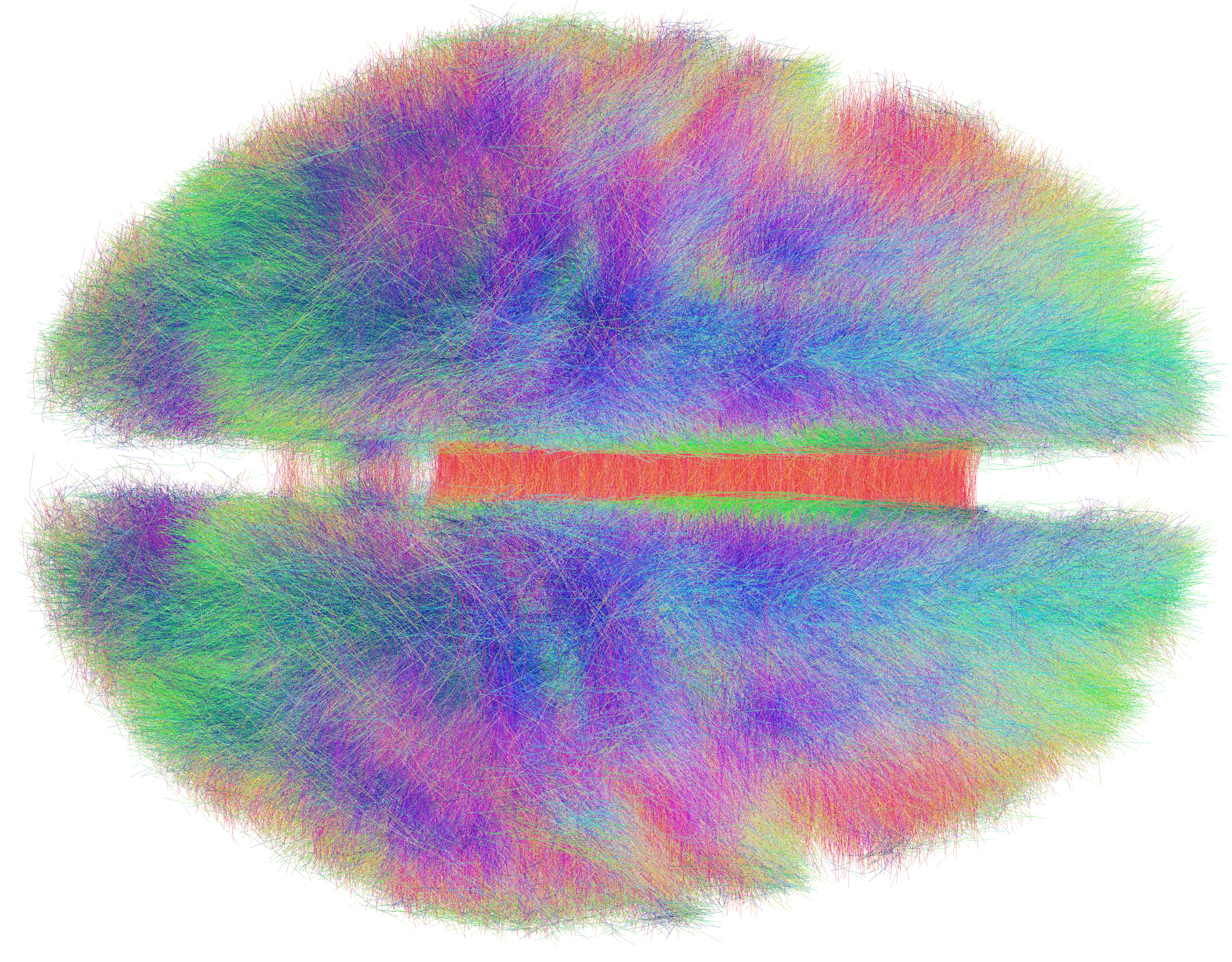
The scan must capture whatever the model needs. At minimum that means the complete synaptic wiring of the brain — the connectome — including which neuron contacts which, where, and through what kind of synapse. Electron microscopy at nanometre resolution can resolve this, but only destructively and only on tissue that has been chemically fixed, stained with heavy metals, embedded in resin, and cut into sections tens of nanometres thick. Every published mammalian connectome fragment has been produced this way. The scale gap is severe: the largest human cortical volume reconstructed to date is about one cubic millimetre, roughly a millionth of a whole brain. See Connectomics.
Translating
A wiring diagram alone specifies almost nothing about dynamics. The translation step must assign to each element a model and a parameter set: membrane properties, channel densities, synaptic strengths and their short-term dynamics, neuromodulatory sensitivities. Some of these can in principle be inferred from structure — synapse size correlates with strength — but many cannot, and current electron microscopy does not read out molecular composition. Correlative approaches that image the same tissue functionally before slicing it, as the MICrONS mouse cortex project did, are the existing partial answer, but they work only on a living animal, not on a preserved brain.
Running
The resulting model must be simulated in something close to real time if the emulation is to interact with anything, and must be embedded in a body or a simulated environment, since a cortex with no sensory input and no motor output has no obvious behaviour to validate against. The roadmap by Anders Sandberg and Nick Bostrom treats the environment and body model as a required component rather than an afterthought.
Levels of detail
The 2008 roadmap organizes the problem as a ladder of modelling levels, from coarse-grained connectivity between brain regions at the top, through analogue population models, spiking networks, detailed compartmental electrophysiology, and metabolic and proteomic detail, down to stochastic molecular dynamics and, at the bottom, quantum-level simulation.2 Each rung down multiplies the storage and computation required by orders of magnitude. The roadmap's central point is not any particular estimate but the structure of the bet: emulation is feasible if and only if the necessary level is high on the ladder. Most computational neuroscientists who engage with the proposal think the spiking-network level is too coarse; almost nobody thinks the quantum level is required.
Why the level mattersThe difference between the coarsest and finest proposed levels is not a factor of ten. It is the difference between a problem that large computing facilities might approach this century and one that exceeds any physically plausible machine. The roadmap does not resolve which applies.
Origins
The idea has two lineages. One runs through science fiction, where stored and reinstantiated minds appear from the 1950s onward. The other runs through the practical demonstration that a nervous system can be mapped exhaustively: the completion of the C. elegans wiring diagram in 1986 showed that "every connection in an animal" was a finite quantity of work rather than a figure of speech.3 Hans Moravec joined the two in 1988, arguing that a brain is a finite-state physical system, that computing capacity was growing fast enough to matter, and that the transfer could be done either by scanning or by piecewise replacement.4 The proposal acquired a technical framework two decades later.
-
1956Fictional precursorArthur C. Clarke's The City and the Stars describes citizens stored as patterns in a central computer and reissued into bodies, an early literary statement of the idea.
-
1986The first complete connectomeWhite, Southgate, Thomson and Brenner publish the full wiring diagram of the C. elegans hermaphrodite nervous system from electron micrographs, a project that took over a decade.
-
1988Mind ChildrenHans Moravec sets out both the destructive-scan and the gradual neuron-by-neuron replacement routes, framing emulation as a foreseeable consequence of computing trends.
-
2005Blue Brain beginsHenry Markram launches a project at EPFL to reconstruct cortical microcircuitry in biophysical detail, the first sustained attempt at bottom-up brain simulation at scale.
-
2008The roadmapAnders Sandberg and Nick Bostrom publish a technical report at the Future of Humanity Institute defining the scan-translate-run framework and its levels of detail.
-
2013–2023The Human Brain ProjectAn EU flagship funded at around a billion euros; after an open letter of protest from hundreds of neuroscientists in 2014 it was restructured away from whole-brain simulation and ended having delivered research infrastructure instead.
-
2024A whole adult brain mappedThe FlyWire consortium publishes the complete synaptic connectome of an adult fruit fly, roughly 140,000 neurons — the first whole brain of an animal with complex behaviour to be reconstructed.
What has actually been built
Nothing that qualifies. The largest published biophysical reconstructions are of cortical microcircuits, not brains: the Blue Brain Project's 2015 model of a rat somatosensory column comprised on the order of thirty thousand neurons and tens of millions of synapses, built from statistical rules rather than from a scan of one animal.5 It reproduced some electrophysiological phenomena and was not an emulation of any individual rat. The Blue Brain Project wound down at the end of 2024.
Large-scale spiking simulations at the level of whole rodent or human cortex have been run on supercomputers, but with randomized connectivity and generic neuron models. They demonstrate that hardware can carry the neuron count; they say nothing about whether the resulting activity corresponds to a mind.
The nearest thing to a substrate for a real emulation arrived in 2024, when the complete synaptic wiring of an adult fruit fly was published — roughly 140,000 neurons with cell-type annotation and predicted neurotransmitter identity.6 Groups have since begun building whole-brain-scale dynamical models from it. These are properly called simulations rather than emulations: they use the anatomy of one fly with parameters fitted or assumed, and their outputs are compared against population statistics rather than against the behaviour of the individual animal that was scanned. That comparison is the test the field needs and has not yet passed.
The most informative negative result comes from the nematode. C. elegans has an invariant nervous system of 302 neurons, a connectome published four decades ago and refined since with sex-specific and developmental detail. The OpenWorm project and related efforts have not produced a simulation that reproduces the animal's behavioural repertoire. The obstacles are exactly the ones the roadmap identifies as the translation step: the connectome does not specify synaptic polarity, strength, or the extrasynaptic neuropeptide signalling that reconfigures the circuit.
Objections
The single-neuron model is not settled. Emulation assumes a validated model of the components. Cortical pyramidal neurons perform nonlinear computation in their dendrites, and the mapping from input to output is not captured by a threshold unit. Attempts to fit a detailed biophysical neuron with an artificial network have required networks of substantial depth, which is a measure of how much is being abstracted away at the spiking level.
Chemistry is not wiring. Neuromodulators diffuse and act on receptors at a distance from any synapse. Eve Marder's work on the crustacean stomatogastric ganglion — a circuit of about thirty neurons whose anatomy has been fully known for decades — shows that the same wiring produces qualitatively different rhythms under different neuromodulatory conditions, and that widely different parameter sets produce identical output.7 A structural scan cannot distinguish those parameter sets. Glia, which outnumber neurons in some regions and modulate synaptic transmission, are absent from most emulation proposals entirely.
Validation has no obvious method. There is no test that distinguishes a correct emulation from a plausible-sounding one. A behavioural comparison requires an original to compare against, and the scan is destructive. The standard proposal is to validate on progressively larger animals first, which is sensible and has not begun. Validation also raises a problem with no precedent in software engineering: a partially correct emulation of a person would be a system that might be conscious and might be suffering, and there is no way to test it that does not consist of running it. Proposals for staged validation on animals inherit the same difficulty in milder form.
The compute estimates are unreliable. Forecasts of the hardware required span many orders of magnitude and depend entirely on the assumed level of detail, which is the unknown. Citing a particular figure alongside a projection of computing growth, as arguments connected to Accelerating change and the Technological singularity often do, imports the conclusion into the premise.
How far offEstimates from within the emulation community typically fall in the second half of this century. Kenneth Miller, a computational neuroscientist at Columbia, argued in 2015 that even mapping the relevant structure of a human brain plausibly requires centuries at any realistic rate of improvement.8 The disagreement is not about the physics; it is about how many unknown parameters the translation step hides.
Relationship to other technologies
Emulation is the destination that gives Brain preservation and, on some readings, Cryonics their rationale: if a preserved brain retains the information an emulation would need, preservation converts a deadline into a storage problem. Whether aldehyde-stabilized or vitrified tissue retains that information is disputed and depends, again, on which level of detail matters.
It is sometimes proposed that a Brain–computer interface could provide the read-out instead of a destructive scan. Current implants sample on the order of a thousand channels from a cortex containing billions of synapses, and record activity rather than structure; the gap is not one that incremental electrode counts close, and the methods of Neural decoding recover motor plans and attempted speech rather than the standing structure that an emulation would need. Person-specific computational models of the body, described under Human digital twins, share the goal of modelling one individual rather than a generic one, at a resolution many orders of magnitude coarser. Emulation is also frequently invoked as a route to Artificial general intelligence that sidesteps the need to understand intelligence, and as the mechanism behind speculative economies of copied minds.
Outlook
The near-term work that would actually bear on the question is unglamorous: automated volume microscopy at higher throughput, better segmentation, molecular labelling of synapse types, and above all a successful emulation of a small animal whose behaviour can be checked. A fly, whose complete connectome now exists and whose behaviour is well characterized, is the obvious test case and the field's clearest near-term falsifier. If a fly connectome plus reasonable biophysical assumptions cannot be made to fly, the scale-separation assumption is in trouble; if it can, the argument moves from principle to engineering. As of 2026 nobody has claimed to have done it.
See also
- Mind uploading
- Connectomics
- Substrate independence
- Brain preservation
- Personal identity and continuity
- Machine consciousness
- Neural correlates of consciousness
- Digital immortality
References
Footnotes
-
paperAzevedo, F. A. C. et al. "Equal numbers of neuronal and nonneuronal cells make the human brain an isometrically scaled-up primate brain." Journal of Comparative Neurology, 2009. ↩
-
reportSandberg, A. and Bostrom, N. "Whole Brain Emulation: A Roadmap." Technical Report 2008-3, Future of Humanity Institute, University of Oxford, 2008.↩An institute technical report, not a peer-reviewed paper; its requirement estimates are conditional on an assumed level of detail.
-
paperWhite, J. G., Southgate, E., Thomson, J. N. and Brenner, S. "The structure of the nervous system of the nematode Caenorhabditis elegans." Philosophical Transactions of the Royal Society B, 1986. ↩
-
bookMoravec, H. Mind Children: The Future of Robot and Human Intelligence. Harvard University Press, 1988. ↩
-
paperMarkram, H. et al. "Reconstruction and simulation of neocortical microcircuitry." Cell, 2015. ↩
-
paperDorkenwald, S. et al. "Neuronal wiring diagram of an adult brain." Nature, 2024.↩A structural reconstruction of one fly brain with predicted neurotransmitters; it carries no physiological recordings from the animal that was scanned.
-
paperMarder, E. "Neuromodulation of neuronal circuits: back to the future." Neuron, 2012. ↩
-
newsMiller, K. D. "Will You Ever Be Able to Upload Your Brain?" The New York Times, 2015.↩A newspaper opinion piece by a computational neuroscientist, arguing a position rather than reporting a result.