Virtual cell models are computational systems that represent what happens inside a cell — DNA, RNA, proteins, regulatory networks and the processes they support — closely enough to predict its behaviour under a condition nobody has tested. Two lineages carry the name. Mechanistic whole-cell models write down every reaction and integrate them forward in time; learned models are trained on millions of measured single cells and asked to predict the next measurement. A complete whole-cell model exists for two of the simplest bacteria known. None exists for any human cell.
Two traditions
A mechanistic whole-cell model aims to account for every annotated gene function in an organism at once. The 2012 model of Mycoplasma genitalium split the cell into 28 submodels covering 28 processes, spanning 401 genes, 722 compounds and 1,857 reactions, and let each submodel use whatever mathematics suited it — flux balance for metabolism, stochastic simulation for transcription — with the submodels resynchronised at short time steps.1 The virtue is interpretability: every prediction traces back to a stated mechanism, and a wrong prediction points at a wrong parameter. The cost is that the parameters have to come from somewhere. That model needed roughly 1,800 of them, assembled from the published literature on an organism with about 525 genes. A human cell has roughly twenty thousand.
Learned models take the opposite route and assume nothing about mechanism. Geneformer converts each cell's expression profile into a sequence of gene tokens ranked by abundance and trains a transformer over roughly 30 million single-cell transcriptomes;2 scGPT and its successors do something similar at comparable scale. What comes out is an embedding, which is then used for cell-type annotation, network inference, and the task the field now treats as decisive: perturbation prediction. Given an unperturbed cell and a gene to silence, predict the transcriptome that results. Nothing propagates through time in these systems. They are regression over a very large corpus, not simulation, and the word "virtual cell" covers both.
Between the two sit genome-scale metabolic reconstructions. Recon3D, published in 2018, catalogues 3,288 human open reading frames, 13,543 reactions and 4,140 metabolites, with protein structures attached.3 It is mechanistic and human and useful, and it is also stoichiometry without kinetics: it constrains what a cell's metabolism can do at steady state rather than saying what it will do next.
Development history
-
1996–1999E-CellMasaru Tomita's group at Keio University builds a simulation environment and assembles a hypothetical self-sustaining cell from 127 genes selected out of the Mycoplasma genitalium genome.
-
2012The first whole-cell modelKarr and colleagues in Markus Covert's laboratory publish a model of Mycoplasma genitalium covering every annotated gene function, and use it to direct experiments that recovered previously unmeasured kinetic parameters.
-
2018Human metabolism reconstructedRecon3D assembles a genome-scale account of human metabolic reactions with associated protein structures, extending an effort begun a decade earlier.
-
2022A minimal cell in silicoA whole-cell kinetic model of the 493-gene synthetic bacterium JCVI-syn3A reproduces how the cell balances metabolism, gene expression and growth across a cycle.
-
2023–2024Single-cell foundation modelsGeneformer and scGPT are trained on tens of millions of transcriptomes and released, moving the field's centre of gravity from equations to learned representations.
-
2024The AI virtual cell proposedA 42-author perspective in Cell sets out what an AI Virtual Cell would have to be: universal representations across scales, queried through virtual instruments, judged against experiment.
-
2025Benchmarks and data at scaleThe Arc Institute releases State and launches the Virtual Cell Challenge; the Chan Zuckerberg Initiative starts the Billion Cells Project with 10x Genomics and Ultima Genomics.
-
2026A bacterial cell cycle in four dimensionsA spatial and kinetic model simulates the roughly 100-minute cycle of JCVI-syn3A end to end, including growth and division.
Where the field stands
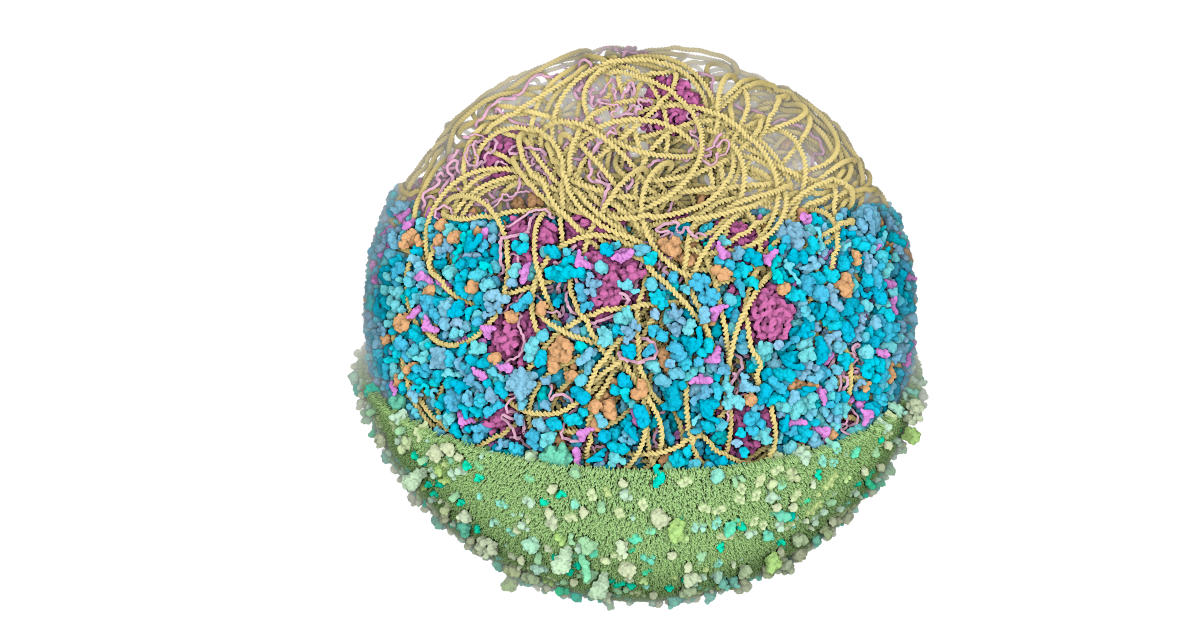
The mechanistic side has reached something close to completeness for one organism. A 2026 model of JCVI-syn3A, the pared-down bacterium built by transplanting a synthetic genome, simulates the whole cell cycle in three spatial dimensions and time, covering genetic information processing, metabolism, growth and division.4 It is the strongest existing demonstration that the approach works, and it took thirty years and an organism with fewer than five hundred genes.
The learned side is where the money and the human cells are. Arc Institute's State was trained on observational data from 167 million cells and perturbational data from over 100 million more, spanning seventy human cell contexts.5 Reporting in Nature put its performance at roughly a third of the genes most strongly affected by a given perturbation in a test set, against 7% for conventional methods.6 Xaira Therapeutics has released a perturbation atlas of 25.6 million cells and a model trained on it; Emma Lundberg's SubCell learns from microscope images rather than transcriptomes, which is one answer to the objection that expression is not the cell. The Chan Zuckerberg Initiative's Billion Cells Project, launched in 2025 with 10x Genomics and Ultima Genomics, exists to supply training data on a scale nobody has had.
Commercial systems claim more. In August 2026 GenBio AI, founded in 2024 with headquarters in Palo Alto and laboratories in Paris and Abu Dhabi, previewed AIDO Cell, which the company describes as a world model of the human cell spanning DNA, RNA, protein, regulatory networks and whole-cell behaviour in one system, covering the K562 and HepG2 tumour-derived cell lines.7 Its co-founders include David Baker, who shared the 2024 Nobel Prize in Chemistry for computational protein design, and its chief scientist Eric Xing had told Nature in June that early-generation models of this kind would be simulations of biology rather than replicas of cellular reality.6 No peer-reviewed description of AIDO Cell had appeared as of late August 2026, and the announcement reported no prospective experimental test.
What the benchmarks show
Independent evaluation has been consistently less flattering than the release notes.
Tested without fine-tuning, the embeddings produced by Geneformer and scGPT failed to separate cell types or remove batch effects robustly across most benchmark datasets, and were beaten on those tasks by older and far cheaper methods including plain selection of highly variable genes.8 On perturbation prediction, a 2025 comparison in Nature Methods put five foundation models and two other deep-learning systems against deliberately simple linear baselines and found that none of them won: for combinations of two genes whose single perturbations had been seen, the deep models did no better than adding the two effects together, and for unseen genes they did no better than predicting the training-set mean.9
The Arc Institute built the Virtual Cell Challenge partly to make this checkable in the open, using around 300 CRISPR-interference perturbations in a human stem cell line as a held-out test set.10 The 2025 round drew entries from more than a hundred countries. None of the purely learned models beat entries that incorporated conventional statistical methods.6
The gap between the name and the objectNo published model of any human cell predicts its behaviour across DNA, RNA, protein and regulation together and has been shown to be right about a condition it was not trained on. What exists is a set of narrow predictors, most of them reading one modality, evaluated retrospectively on data that was collected before the model saw it. Fabian Theis, a computational biologist at Helmholtz Munich, told Nature in June 2026 that he did not think anyone would sensibly claim to have built a virtual cell unless they needed to sell a start-up.6
What makes a cell hard
Parameters nobody has measured. The mechanistic route needs rate constants, concentrations and localisations for every reaction. For bacteria these were assembled from decades of literature. For a human cell most of them have never been measured in any cell, let alone the one being modelled — the same constraint that limits person-scale models one level up.
A noisy readout. Single-cell RNA sequencing is the field's main training signal and it is noisy. Differences a model learns may be biology or may be artefacts of how the sample was handled, and distinguishing the two is an open problem rather than a preprocessing step.
Statics, not dynamics. Learned models capture what a cell state looks like better than they capture how it changes. Perturbation response is a question about change, which is why it remains the hardest benchmark and why it was chosen as the field's test.
One modality is not a cell. The transcriptome says nothing directly about protein abundance, post-translational modification, metabolite pools, or where anything sits in the cell. Image-based and multimodal models exist to close that gap and are much earlier.
The wet lab is the bottleneck. A prediction is worth what an experiment says it is worth, and running that experiment costs more than running the model by orders of magnitude. Retrospective benchmarks are cheap and prospective validation is not, which is why almost every published claim rests on the former.
Equations or embeddingsOne camp holds that only mechanistic models answer interventional questions, because a model fitted to observed data cannot say what happens under a condition never observed, and that interpretability is what makes a wrong prediction useful. The other holds that mechanistic models will stay underdetermined wherever parameters cannot be measured, and that learned models will predict better in practice even while explaining nothing. Hybrid systems that layer learned components onto mechanistic scaffolds are common in preprints and rare in anything validated. The Virtual Cell Challenge result, in which statistical methods held their own against pure learning, is currently read as support by both sides.
Claims, uses and risks
The 2024 perspective that gave the field its programme was careful about what an AI Virtual Cell would have to demonstrate: representations that transfer across scales, a way to interrogate them that resembles an instrument, and evaluation against experiment rather than against held-out data.11 Much of what is marketed under the name meets none of those conditions, and the label has spread faster than the capability behind it — a pattern already familiar from AI drug discovery, where the category has no regulatory definition and therefore no denominator.
The plausible near-term uses are narrower than the name suggests and real. Triaging which perturbations to run in a CRISPR screen, prioritising targets before committing to an organoid or animal experiment, and flagging where a proposed regulatory edit would have off-pathway consequences are all tasks where being usefully better than chance pays. Applications in aging biology are frequently proposed, since Cellular senescence and the other Hallmarks of aging are cell-level phenomena, though the shortage of validated readouts limits what a prediction could be checked against. Altos Labs took the generalist prize in the 2025 challenge, which indicates where some of the interest is coming from.5
Risks are mostly of the ordinary kind. A confident wrong prediction that redirects a research programme costs years, and a model that cannot be inspected is hard to argue with. Training corpora are drawn from immortalised cell lines and from donors who are not representative, so predictions inherit whatever the sampling did, which is the equity problem that follows every biomedical dataset. Compute and data at this scale concentrate the work in a few well-funded institutions. The dual-use concern that attaches to protein design applies weakly here, since a model of how a cell responds to a perturbation is not a design tool for pathogens, though the distinction narrows as the models grow.
Outlook
The test the field has set itself is clear enough to fail. A virtual cell would predict a perturbation's effect in a cell type it was not trained on, and the prediction would hold when someone ran the experiment. Nothing published meets that standard, and the honest reading of the 2025 benchmarks is that scale alone has not yet produced it. Proponents argue that data is the binding constraint and that billion-cell corpora will change the picture; sceptics point out that the same argument was made at each previous order of magnitude, and that a model trained only on transcriptomes may be missing not data but variables.
Two harder questions sit behind the benchmark. Whether cells are predictable at all in the relevant sense is not settled: a cell is a stochastic system, and the useful prediction may be a distribution rather than a state. And a model of a cell in isolation says little about cells in tissue, where signalling between neighbours does much of the work — the reason a virtual cell is not a step on a path that ends at Whole brain emulation, despite the shared vocabulary. On readiness the mechanistic branch is furthest along and applies to bacteria; the branch that applies to human cells is earlier than its funding implies. The claim that progress toward more general AI systems will carry biology along with it is made often here, and the counter-argument is the one that applies to structure prediction in reverse: protein folding had a discrete input, a checkable output and fifty years of curated ground truth, and a cell has none of the three.
See also
- AI drug discovery
- AI protein design
- Human digital twins
- Organoids
- Synthetic genomes
- Whole brain emulation
- Technology readiness level
References
Footnotes
-
paperKarr, J. R. et al. "A Whole-Cell Computational Model Predicts Phenotype from Genotype." Cell, 2012.↩Covers every annotated gene function of Mycoplasma genitalium; the organism has one of the smallest known genomes and no equivalent model exists for a larger one.
-
paperTheodoris, C. V. et al. "Transfer learning enables predictions in network biology." Nature, 2023.↩Introduces Geneformer, pretrained on roughly 30 million single-cell transcriptomes; the paper reports fine-tuned performance rather than out-of-the-box use.
-
paperBrunk, E. et al. "Recon3D enables a three-dimensional view of gene variation in human metabolism." Nature Biotechnology, 2018.↩The reconstruction covers about 17% of functionally annotated human genes and is metabolic only, with no gene regulation or signalling.
-
paperThornburg, Z. R. et al. "Bringing the genetically minimal cell to life on a computer in 4D." Cell, 2026.↩A spatial and kinetic model of the roughly 100-minute cycle of the 493-gene synthetic bacterium JCVI-syn3A, not of a natural or human cell.
-
statementArc Institute. "Arc Institute's first virtual cell model: State," June 2025; and "Virtual Cell Challenge 2025 Wrap-Up: Winners and Reflections," December 2025.↩ ↩2The institute's own accounts: the State training figures and the challenge prize results are reported by the party that built one and ran the other.
-
newsEisenstein, M. "Can biology move into the Matrix?" Nature, vol. 654, 4 June 2026, pp. 286–288.↩ ↩2 ↩3 ↩4A reported feature; the State and challenge figures in it are attributed to the researchers involved rather than independently verified.
-
statementGenBio AI. "AIDO Cell: A General-Purpose Simulator for Cell Biology." Preview announcement, 18 August 2026.↩A company describing its own unreleased system; no peer-reviewed description or prospective experimental validation accompanied it.
-
paperKedzierska, K. Z. et al. "Zero-shot evaluation reveals limitations of single-cell foundation models." Genome Biology, 2025.↩Tests Geneformer and scGPT without fine-tuning against highly variable gene selection, scVI and Harmony on five datasets.
-
paperAhlmann-Eltze, C., Huber, W. and Anders, S. "Deep-learning-based gene perturbation effect prediction does not yet outperform simple linear baselines." Nature Methods, 2025.↩Compares five foundation models and two other deep-learning methods with additive and mean-prediction baselines on single and double perturbations.
-
paperRoohani, Y. H. et al. "Virtual Cell Challenge: Toward a Turing test for the virtual cell." Cell, 2025.↩Describes the benchmark and its dataset of around 300 CRISPR-interference perturbations in H1 human embryonic stem cells.
-
paperBunne, C. et al. "How to build the virtual cell with artificial intelligence: Priorities and opportunities." Cell, 2024.↩A 42-author perspective setting out requirements and open problems; it proposes a programme and reports no model or result of its own.