Longevity escape velocity (LEV) is the hypothetical point at which biomedical progress extends a person's remaining life expectancy by more than one year for every year that passes. Past that threshold the expected date of death recedes faster than the calendar advances, and dying of age-related causes stops being scheduled. The term was named and popularized by Aubrey de Grey in the early 2000s.1 It is an arithmetic claim about rates of improvement, not a claim that any particular therapy works.
Overview
Longevity escape velocity is not a technology, a therapy, or a date. It is a condition on the rate of change of a demographic quantity. Write e(x, t) for the remaining life expectancy of a person aged x in calendar year t. Someone alive today ages one year and simultaneously moves one year into the future of medicine, so their remaining life expectancy changes by the sum of two terms: a loss from being older, and a gain from a year of progress. Escape velocity is reached when the gain exceeds the loss and remaining life expectancy stops falling.
Two consequences follow. The threshold is age-specific rather than universal: a thirty-year-old loses very little remaining life expectancy per year of aging and clears the bar easily, while an eighty-five-year-old loses a great deal and may never clear it. And LEV does not require immortality, a cure for aging, or any single decisive result. It requires sustained, compounding, non-plateauing improvement — each increment buying enough time for the next one to arrive.
The threshold, stated preciselyStandard life tables in low-mortality countries show that a person aged 65 loses roughly eight to ten months of remaining life expectancy for each year they age. Escape velocity at 65 therefore requires medicine to add about that much remaining life expectancy in every calendar year, and to keep doing so indefinitely. The historical rate of gain is roughly a year per decade.
Origins
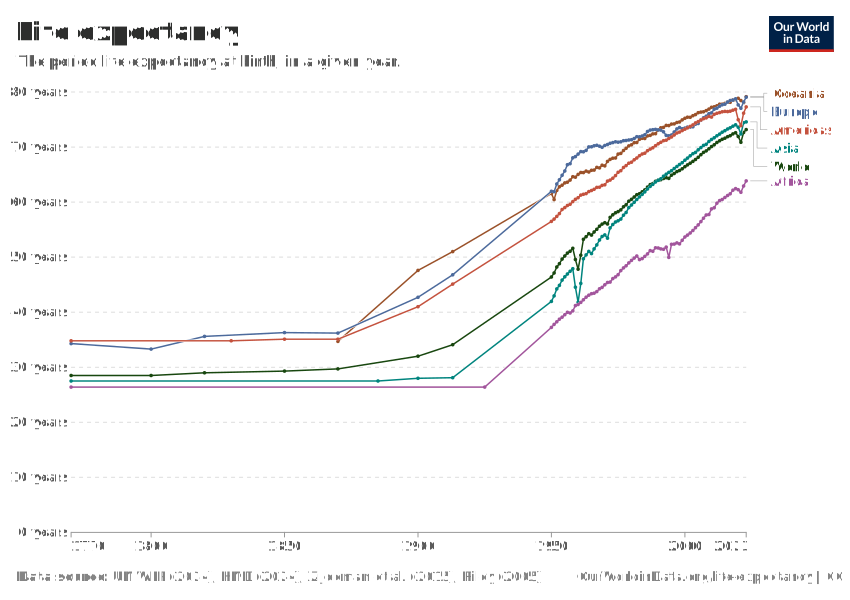
The concept sits at the intersection of two older arguments. The first is the demographic observation that life expectancy in record-holding countries has risen with remarkable regularity — Oeppen and Vaupel reported in 2002 that best-practice female life expectancy had climbed by about three months per year for a century and a half, repeatedly overrunning ceilings that demographers had declared final.2 The second is the engineering framing of aging as accumulated damage that could in principle be repaired, which de Grey developed as Strategies for Engineered Negligible Senescence.
-
1825Gompertz law describedBenjamin Gompertz shows adult mortality rises roughly exponentially with age, doubling on a timescale of about eight years. This exponential is what any escape-velocity argument has to outrun.
-
2002Broken limits to life expectancyOeppen and Vaupel document a linear rise in best-practice life expectancy over 160 years, undermining the idea of a fixed demographic ceiling.
-
2004Escape velocity named in printDe Grey's PLoS Biology essay frames the threshold and argues that reaching it, not curing aging, is the relevant near-term goal.
-
2005–2006The SENS challengeMIT Technology Review offers a prize for a submission showing the SENS programme unworthy of debate. The judges award no prize, concluding that SENS is highly speculative but has not been refuted.
-
2007Ending AgingDe Grey and Michael Rae set out the seven-category damage-repair programme in book form, with escape velocity as its stated objective.
-
2022LEV FoundationAfter leaving the SENS Research Foundation, de Grey founds an organization named for the concept and begins combination-intervention studies in middle-aged mice.
-
2024Demographic pushbackOlshansky and colleagues report in Nature Aging that life-expectancy gains in the world's longest-lived populations decelerated after 1990.
De Grey later used the term Methuselarity for the same threshold, by analogy with the Technological singularity: a point past which the trajectory of a system becomes hard to extrapolate from its history. The analogy is loose, and the escape-velocity formulation is the one that survived.
The argument
The case for LEV has three moving parts.
Aging is damage, and damage can be repaired. The SENS framing divides age-related change into a small number of categories — cell loss, senescent cells, extracellular aggregates, intracellular aggregates, mitochondrial mutations, extracellular crosslinks, and cancerous mutations — and argues that periodic repair of each is easier than understanding metabolism well enough to prevent damage in the first place.3 Repair does not need to be complete; it needs only to keep damage below the threshold at which pathology appears.
Repair buys time for better repair. A first-generation therapy that adds a decade of healthy life to a sixty-year-old delivers them to a medicine ten years more advanced than the one they started with. If the second generation adds more than the first, and the third more than the second, the person's remaining life expectancy stops declining. De Grey's characteristic claim is that the hard step is the first one, because subsequent generations improve an existing platform rather than inventing one.
Sustained exponential improvement is the historical norm in some technologies. Proponents including Ray Kurzweil extend the argument by treating biomedicine as one more information technology whose cost and capability curves will follow those of sequencing and computation. This is the weakest link in the chain and is treated separately below.
Where the disagreement actually isAlmost no biogerontologist disputes that escape velocity is arithmetically coherent, or that it would follow from sufficiently rapid rejuvenation. The dispute is entirely about whether the required rate is remotely achievable, and about whether de Grey's damage taxonomy is complete enough to be a plan rather than a sketch.
What the record shows
The empirical position as of 2026 is unfavorable to near-term escape velocity.
No intervention has been shown to extend maximum human lifespan, and none has been shown to slow human aging on a validated endpoint. The leading geroprotector candidates — Rapamycin, Metformin and the TAME trial, Senolytics, NAD+ precursors — have strong rodent data and either thin, null, or absent human data on aging outcomes. The best-evidenced life-extending intervention available to an individual is still physical activity, which does not obviously compound.
Gains in remaining life expectancy at older ages have run at roughly a year per decade in high-income countries — an order of magnitude short of the threshold. Olshansky and colleagues reported in 2024 that even that rate has decelerated in the longest-lived populations since 1990, and argued that radical life extension this century is implausible without an intervention that acts on aging itself.4 Their earlier work made the related point that eliminating all cardiovascular disease and cancer outright would add fewer years than most people assume, because the underlying aging process would continue to raise mortality from everything else.5
There is also a selection problem in the optimistic reading of the demographic record. Twentieth-century life-expectancy gains came overwhelmingly from reducing early-life mortality — infectious disease, childbirth, infant death — and later from cardiovascular deaths at middle age. Those were one-time wins against causes that are not aging. What remains is the residual exponential that Gompertz described, and no population has yet bent it.
The field also lacks a way to detect escape velocity if it were happening. There is no accepted surrogate endpoint for aging, which is why biomarker validation and the regulatory status of epigenetic clocks matter more to the argument than they appear to. Without one, the only way to confirm that a therapy has bent the mortality curve is to wait decades and count deaths.
Criticism
The compounding assumption is doing all the work. LEV requires that improvements keep arriving at an accelerating or at least non-decaying rate. Most biomedical technologies follow S-curves: rapid early gains, then a plateau as the easy mechanisms are exhausted. Antibiotics, statins, and antiretrovirals each produced a step change and then flattened. Nothing about the history of medicine guarantees a sequence of step changes rather than one.
The damage taxonomy may be incomplete. The SENS categories were proposed as exhaustive on the grounds that no additional damage class had been identified in decades. Critics regard this as an argument from absence, and note that mechanisms such as the loss of transcriptional fidelity, retrotransposon derepression, and chronic sterile inflammation do not sit comfortably in the scheme.
Timelines have repeatedly slipped. De Grey has given roughly even odds of reaching escape velocity within a couple of decades, conditional on funding, for about two decades. Conditioning a forecast on a funding level that never materializes makes it difficult to falsify, and the pattern is a standard failure mode in technology forecasting.
Mice are not a preview. Interventions that extend rodent life reliably do so in short-lived, inbred, pathogen-free animals whose mortality is dominated by cancer, and the same interventions have repeatedly failed to reproduce their effect sizes in longer-lived species. A therapy that adds 20 percent to mouse median lifespan is not a therapy that adds sixteen years to a human one, and treating the two as interchangeable is the most common error in escape-velocity forecasting.
Even total success has a ceiling. If aging were eliminated entirely, mortality would not be zero. Holding annual death rates at the level of a healthy adolescent in a low-mortality country implies a mean lifespan on the order of a thousand years, not an infinite one. LEV is a claim about escaping aging, and the popular conflation with immortality is a misreading.
What "escape velocity" does not meanIt does not mean an individual stops dying, that lifespan becomes unbounded, or that any therapy has been demonstrated. A population could be at escape velocity while its members still died of accidents, infection, and residual disease, and any individual could miss the threshold by being too old when it arrives.
What would have to be true
For LEV to be reached in this century, several things that are currently absent would need to appear, roughly in order:
- A validated surrogate for biological aging that regulators accept as an endpoint, since no trial can otherwise be run on a useful timescale.
- Regulatory acceptance of aging itself as an indication, the explicit goal of the geroscience programme and of the trial design behind TAME.
- At least one intervention that produces a measurable, durable reduction in age-related mortality in humans rather than mice. Reprogramming and transient OSK expression are the most-cited candidates, and neither has entered a well-powered human trial for an aging endpoint as of 2026.
- Repeatability: a second and third generation of therapy that each add more than the last, in people who have already received the first.
- Manufacturing and delivery at a cost that permits population-scale use, or the gains accrue to a small group and the distributional questions dominate.
Prize programmes such as XPRIZE Healthspan and funders including the Methuselah Foundation have targeted the first two of these directly, on the reasoning that measurement, not biology, is the binding constraint.
Outlook
The concept's practical effect has been to reframe what counts as success. A field aiming at escape velocity funds combination trials, repeat dosing, and functional restoration in old animals rather than single-molecule lifespan studies in young ones. That reframing has outlasted the specific timelines attached to it, and it has been absorbed into mainstream Healthspan research without the label.
The open question is not whether escape velocity is coherent but whether biological repair has the right shape for it. Every technology that has ever shown sustained exponential improvement operated on a substrate that humans designed — transistors, sequencing chemistry, error-corrected codes. Aging is a substrate nobody designed, whose failure modes are entangled with the processes that keep an organism alive. Whether a system like that admits of indefinitely compounding repair, or whether each fix exposes a harder one underneath, is not something the argument can settle from the outside. The alternative bets do not depend on the answer: Cryonics, morbidity compression, and the continuation of ordinary incremental medicine each pay off under assumptions that escape velocity does not require.
See also
- Maximum human lifespan
- Healthspan
- Geroscience hypothesis
- Aubrey de Grey
- Negligible senescence
- The longevity dividend
- Overpopulation and life extension
- Cryonics
References
Footnotes
-
paperde Grey, A.D.N.J. "Escape Velocity: Why the Prospect of Extreme Human Life Extension Matters Now." PLoS Biology, 2004.↩An essay arguing that the threshold is the goal worth aiming at; it presents no experimental result and no rate at which repair has actually improved.
-
paperOeppen, J. and Vaupel, J.W. "Broken Limits to Life Expectancy." Science, 2002.↩The series tracks the record-holding country's life expectancy at birth, not remaining life expectancy at older ages, which is the quantity escape velocity is about.
-
bookde Grey, A.D.N.J. and Rae, M. Ending Aging: The Rejuvenation Breakthroughs That Could Reverse Human Aging in Our Lifetime. St. Martin's Press, 2007. ↩
-
paperOlshansky, S.J. et al. "Implausibility of radical life extension in humans in the twenty-first century." Nature Aging, 2024.↩An analysis of national life tables in the longest-lived populations; it measures the rate of past gains and tests no intervention.
-
paperOlshansky, S.J., Carnes, B.A. and Cassel, C. "In Search of Methuselah: Estimating the Upper Limits to Human Longevity." Science, 1990. ↩