Senolytics are drugs that kill senescent cells selectively while leaving dividing and quiescent cells intact. The class was proposed in 2015 on the reasoning that senescent cells survive despite extensive damage because they upregulate a small number of anti-apoptotic pathways, and that transiently blocking those pathways would tip them into cell death.1 In mice, clearing senescent cells improves function in a long list of tissues and has been reported to extend lifespan. In humans the completed trials have been small, mostly uncontrolled, and their results have been modest or negative.
How they work
Senescent cells have withdrawn stably from the cell cycle but remain metabolically active. They enlarge, resist apoptosis, and secrete a mixture of cytokines, chemokines, proteases, and growth factors known as the senescence-associated secretory phenotype (SASP), characterized in the 2000s by groups including those at the Buck Institute for Research on Aging. The SASP is what makes senescent cells plausible drivers of aging rather than inert debris, and its paracrine spread links the process to Inflammaging and to Stem cell exhaustion. Cells reach the state by several routes — telomere attrition in replicative senescence, DNA damage, oncogene activation, severe mitochondrial stress — which is one reason the resulting populations are not biochemically uniform. Cellular senescence treats the cell state itself, including its triggers, markers, and useful roles; this article treats the drugs. Senescence appears in its own right as one of the Hallmarks of aging.
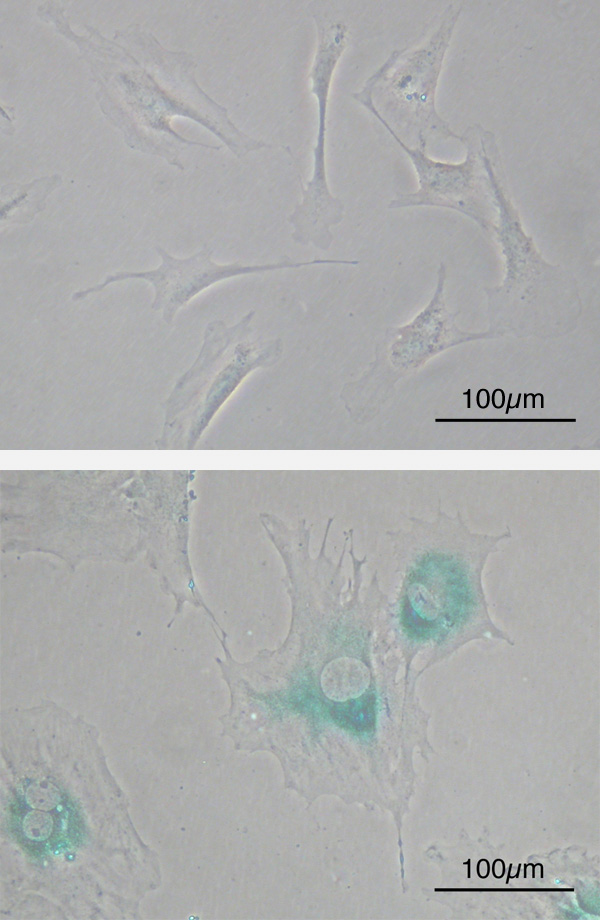
Resistance to apoptosis is the drugging opportunity. Senescent cells depend on what the field calls senescent cell anti-apoptotic pathways: members of the BCL-2 family, PI3K–AKT signalling, p53–p21 regulation, HIF-1α, and heat-shock protein 90. Crucially, different senescent cell types depend on different pathways. Senescent human preadipocytes are killed by dasatinib, an approved kinase inhibitor; senescent endothelial cells are killed by the flavonoid quercetin. Neither alone covers both, which is why the founding paper proposed the combination.
The pharmacology has an unusual feature. Because senescent cells do not divide, a drug does not need to maintain steady-state exposure — it needs only to be present long enough to trigger apoptosis, and the cleared population takes weeks to months to rebuild. This licenses "hit-and-run" intermittent dosing, typically a few days every few weeks, which in principle limits cumulative toxicity from drugs that would be intolerable continuously.
TerminologyA senolytic kills the cell. A senomorphic (or senostatic) leaves it alive but suppresses the SASP; Rapamycin, Metformin and the TAME trial, and JAK inhibitors have all been used this way. The two strategies have different risk profiles and are frequently conflated in press coverage.
Development history
-
1961Replicative senescence describedHayflick and Moorhead report that normal human fibroblasts stop dividing after a finite number of passages, a phenomenon later tied to telomere shortening.
-
2011Genetic clearance in progeroid miceBaker and colleagues use the INK-ATTAC transgene to kill p16-positive cells on demand, delaying cataract, sarcopenia, and fat loss in a fast-aging mouse strain.
-
2015First senolytic drugs identifiedZhu et al. use a transcriptomic screen for anti-apoptotic dependencies to nominate dasatinib and quercetin, and coin the term senolytic.
-
2016Lifespan extension in normally aged miceClearing p16-positive cells from genetically engineered mice raises median lifespan by roughly a quarter and delays several age-related pathologies.
-
2018Senescent cells shown to be sufficientTransplanting a small number of senescent cells into young mice causes persistent physical dysfunction, which senolytic treatment partially reverses.
-
2019First human pilots reportedOpen-label studies in idiopathic pulmonary fibrosis and diabetic kidney disease report feasibility and, in the kidney study, a measurable drop in senescent-cell burden in adipose tissue.
-
2020First randomized failureUnity Biotechnology's UBX0101, injected into osteoarthritic knees, performs no better than placebo in a phase 2 trial.
-
2020Senolytic CAR T cellsAmor and colleagues engineer T cells against the surface protein uPAR, showing that senescent cells can be cleared immunologically rather than pharmacologically.
-
2024Randomized bone trial misses endpointA controlled trial of intermittent dasatinib plus quercetin in postmenopausal women does not meet its primary bone-turnover endpoint.
The idea that accumulated "death-resistant cells" constitute a distinct, separately treatable form of age-related damage predates the drugs. It appears as one of the seven categories in the damage-repair framework that Aubrey de Grey and the SENS Research Foundation promoted from the early 2000s, at a time when the mainstream view still treated senescence mainly as a cell-culture artefact. The 2011 and 2016 mouse clearance experiments moved the question from argument to experiment, which is why they are cited far outside biogerontology.
Drug candidates
Dasatinib plus quercetin (D+Q) remains the most-studied combination and the one used in nearly every human pilot. Dasatinib is a tyrosine kinase inhibitor approved for chronic myeloid leukaemia, with a real oncology toxicity profile including cytopenias, bleeding risk, and pleural effusion. Quercetin is a widely sold plant flavonoid with poor and variable oral bioavailability, which complicates any inference about dose.
Fisetin, another flavonoid, showed senolytic activity and healthspan effects in aged mice and has attracted disproportionate consumer interest because it is sold as a supplement. Its human evidence base is thin, and the bioavailability problem is worse than quercetin's.
Navitoclax (ABT-263) inhibits BCL-2, BCL-xL, and BCL-W, and clears senescent cells efficiently in mice, including in aged haematopoietic stem cells.2 Its dose-limiting thrombocytopenia follows directly from the mechanism: platelets depend on BCL-xL for survival. Efforts to separate the effects include BCL-xL-selective degraders built as PROTACs, which are designed to spare platelets because platelets lack the machinery to execute targeted protein degradation.
Unity Biotechnology pursued locally injected senolytics to avoid systemic exposure. UBX0101, an MDM2–p53 interaction inhibitor for knee osteoarthritis, failed its randomized phase 2. The company's subsequent lead, UBX1325 (foselutoclax), a BCL-xL inhibitor injected into the eye for diabetic macular edema, has produced phase 2 data the company describes as favourable; an independent confirmatory trial had not been published as of 2026.
Beyond small molecules, cardiac glycosides such as ouabain and digoxin have been reported to have broad senolytic activity, and immunological approaches (senolytic CAR T cells directed at uPAR,3 and vaccines raised against senescence-associated surface antigens) offer the prospect of a single treatment with lasting effect rather than repeated dosing. Researchers have also explored gene-delivered constructs that place a killing gene under the control of a senescence-responsive promoter, which would reproduce in a treatable animal what the INK-ATTAC transgene achieved by design.
Human evidence
The human record is short and must be read carefully. The idiopathic pulmonary fibrosis pilot enrolled fourteen patients with no control group and reported improvements in walking-based physical function measures, which in an open-label study of a symptomatic population cannot be separated from expectation and practice effects.4 The diabetic kidney disease study, with nine participants, is more informative on mechanism than on benefit: adipose and skin biopsies showed reduced senescent-cell markers days after dosing, establishing target engagement in at least one tissue.5 A pilot in Alzheimer's disease established that the drugs are tolerated in that population and that dasatinib reaches cerebrospinal fluid, without addressing efficacy.
The most rigorous test to date is a randomized trial of intermittent D+Q in postmenopausal women with bone-turnover endpoints, which did not meet its primary endpoint; the authors reported signals in prespecified subgroups, which is hypothesis-generating rather than confirmatory.6 Combined with the UBX0101 failure, the pattern is a field whose animal data are strong and whose human data are, so far, unpersuasive.
The missing measurementNo validated assay reports senescent-cell burden in a living human across tissues. Without one, trials cannot confirm that a drug engaged its target in the organ of interest, dose selection is guesswork, and a null result cannot be distinguished from an underdosed one. This is the same surrogate-endpoint gap that constrains the whole of geroscience measurement.
Limitations and unresolved biology
Senescence is not simply damage: it suppresses tumour formation, participates in wound healing and tissue remodelling, and has a programmed role in embryonic development, all set out under Cellular senescence. Indiscriminate clearance is therefore not obviously safe. In mice, deleting p16-high cells damaged liver sinusoidal endothelial cells and perivascular cells, producing fibrosis and impaired clearance from the blood.7
The marker problem runs deeper than assay development. There is no single molecular signature of senescence, and the cells that carry the usual markers differ by tissue, inducing stimulus, and time since induction, so a drug that kills one senescent population may leave another untouched — the heterogeneity problem in its therapeutic form. The NIH-funded Cellular Senescence Network was established in part to build the tissue atlases it requires.
Mouse-to-human translation carries the field's usual discount. Many striking results come from progeroid strains, from irradiated or transplanted models, or from young animals given senescent cells experimentally. Laboratory mice are short-lived, inbred, and housed in conditions that exaggerate some pathologies and suppress others, and the relationship between "delays a pathology in a mouse" and "changes an outcome in an eighty-year-old" is not established for any senolytic.
A related trap is the use of composite molecular readouts as evidence of benefit. Senolytic treatment can shift an Epigenetic clocks estimate or a panel of inflammatory markers without any demonstrated change in how a person functions, and a shift in estimated biological age is a change in a prediction, not in an outcome. Regulators have not accepted any such readout as a surrogate endpoint, which means senolytic trials must still be powered on events or on measured function, and therefore remain long and expensive.
Risks
The systemic senolytics under study are not benign compounds. Dasatinib carries oncology-grade toxicity; navitoclax-class agents cause thrombocytopenia; quercetin and fisetin interact with drug metabolism at high doses. Repeated clearance over years has no safety precedent, and the theoretical concern that removing senescence removes a tumour-suppressive brake has not been tested on a human timescale.
A separate risk is commercial. Fisetin and quercetin are sold as supplements with senolytic marketing claims that far outrun the evidence, at doses chosen from mouse studies with no human pharmacokinetic basis. This is the recurring pattern in longevity medicine, shared with NAD+ precursors and with off-label mTOR-inhibitor use: a plausible mechanism, an unregulated product, and no outcome data. Against that background it is worth noting the comparator. The best-supported intervention for the functional endpoints senolytic trials target, among them mobility, frailty, and cardiorespiratory capacity, is structured exercise, and dietary approaches such as Caloric restriction have a far longer animal record than any senolytic. A drug that cannot add to those has little claim on healthy people.
Outlook
Three developments would change the picture. The first is a validated, tissue-resolved measure of senescent-cell burden, which would convert trials from guesswork into pharmacology. The second is a randomized trial with a functional endpoint such as mobility, frailty, or visual acuity, run in a population with a high senescent-cell load, powered properly and controlled. The third is targeting: prodrugs activated by senescence-associated enzymes, antibody-directed delivery of the kind developed for tumour-directed payloads, or engineered immune clearance would let the field escape the systemic toxicity ceiling that limits current compounds.
Senolytics remain among the most advanced tests of the Geroscience hypothesis — the claim that hitting a shared upstream driver of aging beats treating diseases one at a time. Competitions such as XPRIZE Healthspan, which reward measured restoration of muscle, cognitive, and immune function in older adults, are structured to reward exactly that kind of demonstration, and senolytics are among the candidate interventions entrants have pursued. Success at that level would be evidence for Compression of morbidity, not for the far stronger claims about indefinite lifespan extension that the class is sometimes recruited to support.
If the approach works in humans it would most likely first prove itself in a narrow indication with a measurable organ endpoint rather than as a general anti-aging drug. If it does not, the informative question will be whether the failure lies in the biology, in the compounds, or in the continuing inability to measure what the compounds are supposed to be doing.
See also
- Cellular senescence
- Hallmarks of aging
- Inflammaging
- Rapamycin
- Aging biomarkers
- Geroscience hypothesis
- Healthspan
- XPRIZE Healthspan
References
Footnotes
-
paperZhu, Y. et al. "The Achilles' heel of senescent cells: from transcriptome to senolytic drugs." Aging Cell, 2015.↩The anti-apoptotic dependencies were identified in cultured cells; dasatinib and quercetin were existing compounds repurposed against them, not molecules designed for the target.
-
paperChang, J. et al. "Clearance of senescent cells by ABT263 rejuvenates aged hematopoietic stem cells in mice." Nature Medicine, 2016. ↩
-
paperAmor, C. et al. "Senolytic CAR T cells reverse senescence-associated pathologies." Nature, 2020. ↩
-
paperJustice, J.N. et al. "Senolytics in idiopathic pulmonary fibrosis: results from a first-in-human, open-label, pilot study." EBioMedicine, 2019. ↩
-
paperHickson, L.J. et al. "Senolytics decrease senescent cells in humans: preliminary report from a clinical trial of dasatinib plus quercetin in individuals with diabetic kidney disease." EBioMedicine, 2019. ↩
-
paperFarr, J.N. et al. "Effects of intermittent senolytic therapy on bone metabolism in postmenopausal women: a randomized controlled trial." Nature Medicine, 2024. ↩
-
paperGrosse, L. et al. "Defined p16High senescent cell types are indispensable for mouse healthspan." Cell Metabolism, 2020.↩Clearance here was genetic and sustained rather than a short drug course, so the result bounds the hazard of indiscriminate clearance without measuring what an intermittent senolytic would do.