Medical nanorobots are hypothetical machines, roughly the size of a virus or a small bacterium, that would circulate in the body and perform mechanical work on it: clearing a plaque, digesting a pathogen, replacing a chromosome, reporting on a tissue's state. No such device exists as of 2026, and none is in clinical trials. What exists is a set of much simpler objects that the popular literature often calls nanorobots — passive drug-carrying particles, DNA structures that spring open when they meet a molecular signal, and micron-scale swimmers steered from outside the body by magnetic fields.
The design tradition
The lineage starts with a lecture. In 1959 Richard Feynman told the American Physical Society that nothing in physics forbade manipulating matter atom by atom, and relayed a suggestion from his colleague Albert Hibbs that one might one day "swallow the surgeon" — a machine small enough to travel to a diseased site and operate there.1 The idea sat mostly dormant for twenty-five years.
Eric Drexler revived it as an engineering programme. Engines of Creation (1986) described a world in which programmable molecular assemblers build atomically precise devices, including cell-repair machines that would enter tissue, identify damage, and correct it. Nanosystems (1992) supplied the quantitative case: bearings, gears, and computers built from diamondoid carbon lattices, analysed with the tools of mechanical engineering rather than chemistry.
Robert Freitas took the medical branch furthest. His multi-volume Nanomedicine worked through specific device designs — the respirocyte, an artificial red cell; the microbivore, an artificial white cell that would trap and digest bacteria on a "digest and discharge" cycle; the clottocyte; the chromallocyte, which would replace a cell's chromosomes.2 Each targets a function conventional medicine handles badly: the respirocyte competes with the oxygen carriers that have repeatedly failed in trials, described in Artificial blood, and the microbivore with antibiotics against resistant organisms. Each is also a numerical design study, not a prototype. Freitas is explicit that this is exploratory engineering: analysis intended to show that a design violates no physical law, which is a much weaker claim than showing it can be built.
That distinction is where most public discussion of nanorobots goes wrong. The design tradition has produced no device and, as of 2026, no fabrication route to one.
What the physics requires
A micron-scale machine inhabits a world governed by viscosity and thermal noise rather than momentum. Its Reynolds number is on the order of 10⁻⁵: water behaves like heavy syrup, inertia is irrelevant, and a swimmer that stops propelling itself stops moving within a fraction of its own body length. Edward Purcell's 1977 lecture on this regime established the constraint that any reciprocal motion — a scallop opening and closing, an oar stroked forward and back — produces zero net displacement, so propulsion must be non-reciprocal, like a rotating helix or a beating flagellum.3
Brownian motion adds a second constraint. A 100-nanometre particle is kicked hard enough by water molecules to diffuse several micrometres a second in random directions, which is comparable to the speeds achieved by the best synthetic swimmers. Directed motion at that scale is a matter of biasing a random walk, not driving along a path.
Then there is the flow. Blood in the aorta moves at roughly half a metre per second, thousands of times faster than any demonstrated microswimmer. A device released into circulation goes where the blood goes; swimming upstream in a large vessel is not an option, and the useful manoeuvring happens only in capillaries, in the gut, or in relatively still compartments such as the eye or the bladder.
Power is the hardest constraint of all. Onboard chemical fuel runs out; many demonstrated catalytic motors run on hydrogen peroxide at concentrations that would be toxic in a person. Freitas's designs assume a glucose-and-oxygen engine drawing on blood chemistry, which no one has built. External power avoids the storage problem but introduces a scaling one: the force a magnetic field gradient exerts on a particle falls with the particle's volume, so shrinking the device by ten reduces the available force by a thousand, and clinical-scale electromagnets must produce their gradients across a whole human torso.
Communication is similarly awkward. A device a micrometre across cannot carry a radio antenna of useful efficiency. Acoustic signalling is the standard proposal, and ultrasonic power and telemetry have been demonstrated at the millimetre scale in Neural dust and ultrasonic implants implants, which are thousands of times larger by volume than the devices imagined here.
TerminologyIn the peer-reviewed nanomedicine literature, "nanorobot" almost always denotes a passive nanostructure with one stimulus-responsive behaviour — a shell that opens at low pH, or an aptamer latch that releases on binding. It rarely denotes anything with onboard control, sensing, and actuation. The word carries a heavier meaning in popular coverage than in the papers it describes.
What actually exists
Approved nanomedicine is passive. Liposomal doxorubicin, approved in 1995, changed a drug's biodistribution and toxicity profile without doing anything mechanical. Albumin-bound paclitaxel and the Lipid nanoparticles behind mRNA vaccines and the first systemic in vivo CRISPR therapies work the same way: they are formulations, not machines. The clinical value of nanoscale medicine so far comes almost entirely from altering where a drug goes and how fast it is cleared, the subject of Targeted drug delivery.
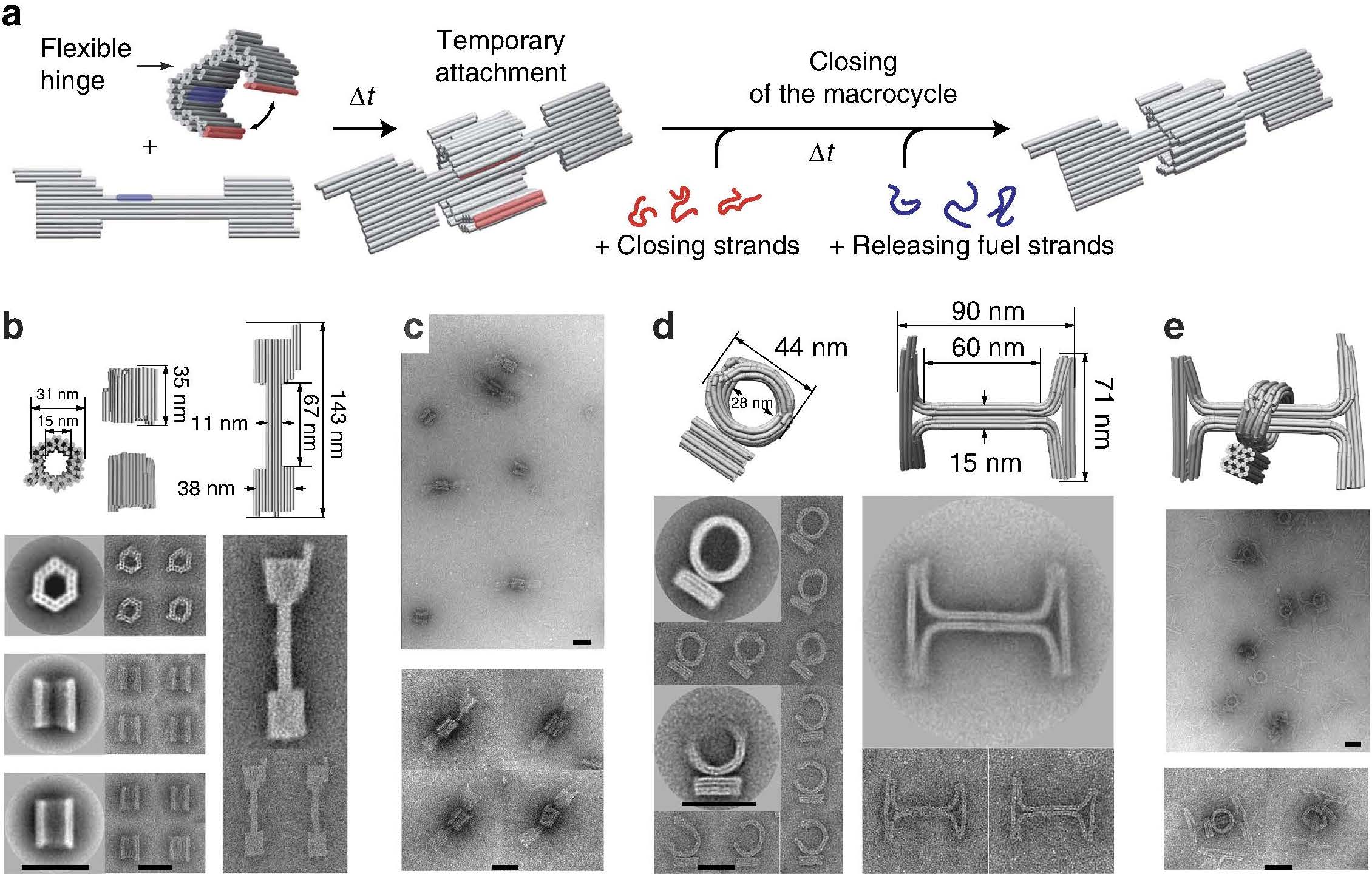
The closest thing to a programmable device comes from DNA nanotechnology. In 2012 a Harvard group built a barrel-shaped DNA origami container held shut by aptamer latches that opened only in the presence of specific cell-surface antigens, delivering antibody fragments to leukaemia cells in culture.4 In 2018 a collaboration reported DNA origami tubes carrying thrombin, sealed by an aptamer that unlatches on nucleolin — a protein exposed on tumour vasculature — which induced clotting in tumour blood vessels and slowed growth in mice.5 These are genuine logic-gated devices. They are also single-function, non-motile, and demonstrated in animals rather than people.
Motile systems live at the micrometre scale rather than the nanometre one, and belong to the separate literature on Medical microrobots. Magnetically driven helices, catalytic micromotors that have been imaged operating in a mouse stomach, and biohybrids built from magnetotactic bacteria have all been steered through tissue in animals. All of them are directed from outside; none decides anything.
Sensing has gone further than actuation. Nanoscale devices that report rather than repair — pore-based single-molecule readers, particles that release urinary markers when they meet a disease-associated enzyme — are already diagnostic tools, as Nanoscale diagnostics describes. Reading the body at molecular resolution turns out to be far easier than acting on it.
Biology supplies the existence proof that machines of this size can work. The ribosome, kinesin walking along a microtubule, and ATP synthase are molecular machines with moving parts, built by self-assembly and powered by chemistry. The 2016 Nobel Prize in Chemistry recognised synthetic molecular machines — rotaxanes, catenanes, and light-driven rotary motors — but the gap between a molecule that rotates in solution and a device that navigates a bloodstream remains almost entirely unbridged.
Manufacture and immunology
Two problems sit between the design studies and any prototype.
The first is fabrication. Drexler's route runs through mechanosynthesis: positionally controlled chemical reactions building diamondoid structures atom by atom. Richard Smalley disputed that this was chemically possible, and the resulting exchange ended without an experimental test. No mechanosynthetic fabrication system has been built. The routes that have produced working nanostructures — DNA self-assembly, supramolecular chemistry, block copolymer templating — deliver structures with limited stiffness, limited internal complexity, and no ability to make covalently rigid machines to specification.
Scale compounds it. A therapeutic dose of any circulating device would need something on the order of a trillion units, each functional, each sterile, each within tolerance. Regulators would have to characterise a heterogeneous population rather than a single machine. Nothing in current pharmaceutical manufacturing is a model for this.
The second problem is that the body defends itself, and a machine has more to lose from that than a formulation does. A drug carrier only needs to last long enough to release its cargo. A device with sorting rotors, sensors, and moving surfaces has to keep those interfaces clean while it works, and the layer of adsorbed plasma protein that settles on anything injected into blood would foul precisely the parts the design depends on. Rigid objects a micrometre across are also close to the size and shape that macrophages are built to swallow whole. Freitas devoted an entire volume of Nanomedicine to biocompatibility, and the analysis is careful, but it is analysis of surfaces that have never been synthesised.
ContestedWhether atomically precise diamondoid machinery can be built at all is unresolved rather than settled in either direction. The mainstream chemistry community largely stopped engaging with the question after the early 2000s; proponents read that as neglect, critics as a verdict. What is not contested is that nobody has built one.
Criticism
The strongest criticism of the nanorobot programme is not that it is impossible but that it has been unfalsifiable in practice. Design studies accumulate; experiments do not follow, because the fabrication technology the designs presuppose does not exist. Forty years after Engines of Creation, the field's concrete achievements — DNA origami, molecular motors, drug-carrying particles — arrived through chemistry and self-assembly rather than through the mechanical-engineering approach the designs assume.
A second criticism concerns the transfer of authority from design to expectation. Because the analyses are quantitative, they read as engineering forecasts, and popular coverage has repeatedly treated them as such. Predictions that circulating repair machines would arrive within a few decades, made in the 1990s and repeated by figures including Ray Kurzweil, have not aged well. The same overreach helped make Grey goo a policy issue in the early 2000s, distorting the regulation of nanomaterials whose actual risks were toxicological, and it supplied the literature on Human enhancement with a stock image — the body continuously maintained from within — that has no laboratory counterpart.
Set against this, the class of problems nanorobots are supposed to solve is real. Removing lipofuscin and other intracellular aggregates, clearing amyloid, repairing individual cells rather than replacing tissue — these appear in serious proposals for intervening in the Hallmarks of aging, and no current modality addresses them well. Senolytics eliminate a cell type rather than repairing one; CRISPR–Cas9 rewrites sequence but cannot remove an aggregate; drugs act on molecular targets and not on structures. The appeal of the nanorobot is that it is the only proposed answer to that class of problem, which is a reason to keep studying it and not a reason to expect it.
Outlook
The near-term trajectory in this space runs through externally controlled microrobots and stimulus-responsive nanostructures rather than autonomous machines. Both are limited by the same two things: getting energy into a small object inside a body, and seeing where the object is once it is there. Real-time imaging of a micron-scale device at depth in a human being remains unsolved, and without it there is no control loop and no regulatory path. On the scale used in Technology readiness level, the whole class sits at the bottom, and the design literature's habit of quoting performance figures for devices at that stage is the main reason it is mistrusted by clinicians.
If autonomous in-body devices ever arrive, the argument that they will come from biology rather than from mechanical engineering deserves more weight than it usually gets. Engineered cells already sense, move, replicate, and act; a bacterium modified to seek a tumour and release a payload is closer to a working medical nanorobot than any diamondoid design, and it raises the containment questions that appear in Gene drives and Mirror life rather than the ones the design tradition anticipated. The Xenobots built from frog cells make the point from the other side: they move on their own beating cilia because they are assembled from living cells rather than fabricated, and they are hundreds of times larger than the devices imagined here.
See also
- Respirocytes
- Molecular assembler
- DNA nanotechnology
- Medical microrobots
- Targeted drug delivery
- Grey goo
- Eric Drexler
- Nanoscale diagnostics
References
Footnotes
-
paperFeynman, R.P. "There's Plenty of Room at the Bottom." Lecture to the American Physical Society, Caltech, 1959; published in Engineering and Science, 1960. ↩
-
bookFreitas, R.A. Nanomedicine, Volume I: Basic Capabilities. Landes Bioscience, 1999.↩Exploratory engineering: numerical design studies meant to show a device would break no physical law, which is a much weaker claim than that it can be built.
-
paperPurcell, E.M. "Life at low Reynolds number." American Journal of Physics, 1977. ↩
-
paperDouglas, S.M., Bachelet, I., Church, G.M. "A logic-gated nanorobot for targeted transport of molecular payloads." Science, 2012.↩Cultured cells, not an animal or a person; the device is a latch that opens on binding, with no onboard power, sensing, or motion.
-
paperLi, S. et al. "A DNA nanorobot functions as a cancer therapeutic in response to a molecular trigger in vivo." Nature Biotechnology, 2018.↩In vivo here means tumour-bearing mice; the structure is non-motile and delivers one payload on one trigger.