Loading
Old version — revision 1
This is a fixed snapshot of Deep brain stimulation, saved by Import as part of the initial corpus import. It is not edited and it is not updated; the article may have changed since.
Edit summary: Initial import of content/deep-brain-stimulation.md — the filesystem corpus, unchanged. Not an edit.
Deep brain stimulation
A surgical therapy in which implanted electrodes deliver continuous electrical pulses to specific deep brain structures to suppress the symptoms of movement and psychiatric disorders.
InterventionEstablishedpresentTRL 9revision 1
15.9 kB1,406 wordsCyberneticsfrontmatter date 2026-07-27
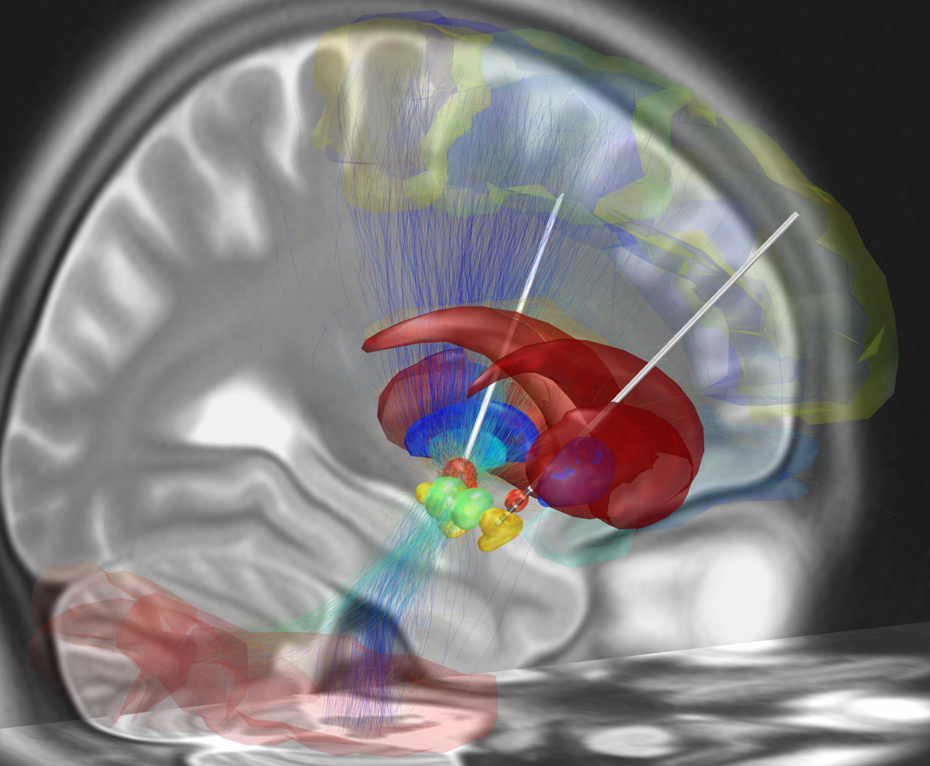
Deep brain stimulation (DBS) is the delivery of continuous electrical pulses through electrodes implanted in specific subcortical structures, controlled by a pulse generator placed under the skin of the chest. It is the most widely used implanted neurotechnology after the Cochlear implant, and it is unusual among the technologies covered on this wiki in being both routine and poorly understood: DBS reliably suppresses the motor symptoms of Parkinson's disease without a settled account of why.
How it works
A quadripolar or segmented lead, roughly 1.3 mm in diameter, is placed stereotactically with millimetre accuracy, often with the patient awake so that clinical response and side effects can be tested intraoperatively. The lead is tunnelled under the scalp and connected to an implanted pulse generator. Stimulation is typically delivered at 130–185 Hz with pulse widths of tens of microseconds, and each contact can be turned on independently, allowing a clinician to steer the field away from structures that produce side effects.
The mechanism is contested. High-frequency stimulation was first assumed to inhibit the target, because its effects resemble those of a lesion. The evidence now points elsewhere. Stimulation excites axons more readily than cell bodies, so a high-frequency train imposes a regular, information-free firing pattern on the output pathway — an "informational lesion" that overwrites pathological bursting rather than silencing it. Antidromic activation of cortical afferents, modulation of the wider cortico-basal-ganglia loop, and effects on astrocytes and local blood flow all contribute. What DBS does not do is restore normal circuit function, and this matters clinically: it treats symptoms driven by abnormal network dynamics and does nothing for the underlying degeneration.
Development history
-
1950s–1960sStereotactic stimulation exploredNeurosurgeons use intraoperative stimulation to localize targets before making destructive lesions, and a handful of chronic stimulation experiments are attempted for pain and psychiatric illness.
-
1987Chronic thalamic stimulation for tremorAlim-Louis Benabid and Pierre Pollak in Grenoble report that chronic high-frequency stimulation of the ventral intermediate thalamus suppresses tremor as effectively as thalamotomy, and is reversible and adjustable.
-
1997First US approvalThe FDA approves thalamic stimulation for essential tremor and parkinsonian tremor.
-
2002Subthalamic and pallidal targets approvedApproval extends to the subthalamic nucleus and globus pallidus interna for advanced Parkinson's disease, the indication that now accounts for most implants.
-
2003–2009Dystonia and OCDHumanitarian device exemptions cover dystonia and, later, treatment-resistant obsessive-compulsive disorder.
-
2013–2017Depression trials failTwo industry-sponsored randomised trials of DBS for treatment-resistant depression are halted for futility, chilling psychiatric applications for several years.
-
2018Epilepsy indicationStimulation of the anterior nucleus of the thalamus is approved in the United States for drug-resistant focal epilepsy.
-
2020sSensing and adaptive systemsPulse generators capable of recording local field potentials reach the market, and the first commercial closed-loop systems that adjust stimulation to beta-band activity are cleared in Europe and the United States in 2025.
Established indications
Parkinson's disease is the dominant use. Randomised trials comparing stimulation of the subthalamic nucleus with best medical therapy in patients with motor fluctuations found substantial improvement in quality of life and in time spent with good mobility.1 A later trial extended the benefit to patients earlier in the disease course, with fluctuations but less disability than the classical surgical candidate.2 Stimulation of the globus pallidus interna produces comparable motor benefit; subthalamic stimulation permits larger reductions in dopaminergic medication, while pallidal stimulation is associated with fewer neuropsychiatric effects in some comparisons.3
Essential tremor and dystonia are the other well-established indications. Tremor suppression by thalamic stimulation is often dramatic, though habituation over years is common. Dystonia responds more slowly, over weeks to months, which complicates programming.
Drug-resistant epilepsy is treated with thalamic stimulation, and a separate class of responsive neurostimulation devices detects seizure onset from cortical electrodes and delivers stimulation only when a pattern is recognized — closer in architecture to a Brain–computer interface than to conventional DBS.
Psychiatric applications
Psychiatric DBS is the field's cautionary tale and its most interesting open question. Two industry-sponsored randomised trials of stimulation for treatment-resistant depression, one targeting the subcallosal cingulate and one the ventral capsule/ventral striatum, were stopped after interim analyses indicated they would not separate from sham.4 Open-label follow-up of subcallosal cingulate patients nonetheless reported durable response over years in a majority of a small cohort, suggesting that the failures reflected trial design, target localization, and the slow time course of antidepressant response rather than a null effect.
Two developments revived the area. Tractography-guided targeting individualizes the electrode position to a patient's own white-matter bundles rather than to atlas coordinates. And a single-patient demonstration used a chronically implanted sensing-and-stimulation device to identify a personal biomarker of depressed state in the amygdala and trigger ventral striatum stimulation only when it appeared, an approach that borrows directly from Neural decoding.5 That result involves one participant. A pivotal trial in treatment-resistant depression is under way as of 2026; obsessive-compulsive disorder remains approved under a humanitarian exemption with a modest evidence base. Treatment-resistant depression draws every available modality, down to the drug-plus-psychotherapy protocols described under Psychedelic therapy, and the recurring difficulty is common to all of them: separating what a treatment does from what a patient who knows they are being treated reports.
Adaptive stimulation
Conventional DBS runs open loop: fixed parameters, day and night, regardless of what the brain is doing. Adaptive DBS uses the implanted lead as a sensor, extracting a control signal — most often power in the beta band, 13–30 Hz, which correlates with rigidity and bradykinesia in Parkinson's disease — and modulating stimulation amplitude in response. Early crossover studies showed that adaptive stimulation could match or exceed continuous stimulation while delivering substantially less total current, which reduces stimulation-induced dyskinesia and speech disturbance and extends battery life.6
Commercial sensing generators arrived in 2020, and closed-loop control reached the market in 2025. The engineering constraints are the interesting part: the stimulation artefact swamps the signal being sensed, biomarkers drift, and a controller that misreads state can oscillate. These are the same problems that limit any chronic implanted decoder, and progress here transfers directly to Neuroprosthetics more broadly.
Effects on personality and agency
Stimulation of the subthalamic nucleus can produce impulsivity, hypomania, pathological gambling, hypersexuality, and apathy, and these effects are dose- and contact-dependent. They arise partly from the target's proximity to limbic and associative territory and partly from the rapid reduction in dopaminergic medication that surgery permits. Most resolve with reprogramming or medication adjustment. A distinct and less tractable phenomenon is the mismatch that sometimes appears between restored motor function and a patient's psychosocial adjustment.
Qualitative studies of DBS recipients record a spectrum of reported self-change, from patients who say the device restored them to themselves to a minority who describe estrangement from their own behaviour.7 The philosophical literature has used these reports to press questions about authenticity and authorship of action that also arise, in weaker form, for psychopharmacology, and that bear directly on Personal identity and continuity and on proposals for Moral enhancement. Empirical work suggests the frequency of severe personality change has been overstated in the Bioethics of enhancement literature relative to what clinical series show. The more common complaint is mundane and important: dependence on a device, a battery, and a clinic.
Consent under a working deviceA patient whose symptoms are controlled by stimulation may be unable to assess the treatment without it, since turning the device off restores the disorder. This makes withdrawal of consent practically asymmetric in a way that ordinary drug trials avoid, and it is a recurring theme in Neurorights discussions of implanted therapy.
Limitations and risks
Intracranial haemorrhage occurs in a small percentage of implantations and is the most serious surgical complication. Hardware problems — infection requiring explantation, lead fracture or migration, skin erosion over the connector — are more common than brain injury and account for much of the reoperation burden. Stimulation-induced side effects include dysarthria, paraesthesia, gait freezing, and eyelid apraxia; most are reversible by reprogramming, which is itself a labour-intensive process requiring an expert clinician and, historically, many hours of trial and error.
DBS does not slow disease progression. Axial symptoms — postural instability, freezing of gait, speech and swallowing difficulty — respond poorly and continue to worsen, and only a disease-modifying approach such as dopaminergic cell replacement from Induced pluripotent stem cells would address the underlying loss. Cost and the requirement for a specialist centre restrict access sharply, and the geographic distribution of implantation rates tracks health-system wealth rather than disease burden, an instance of the pattern examined in Access and inequality.
Outlook
Three trajectories are visible. Sensing-enabled hardware turns every implanted patient into a source of chronic intracranial recordings, a data resource with no precedent in human neuroscience and obvious implications for Mental privacy. Directional leads and patient-specific field models built from a recipient's own imaging, a clinical instance of the approach described under Human digital twins, are making programming semi-automatic. And non-invasive alternatives are eroding the market at the margins: magnetic-resonance-guided focused ultrasound already ablates the thalamic tremor target without an incision, and low-intensity variants under Non-invasive neuromodulation aim to modulate deep structures reversibly.
The unresolved scientific question is whether DBS can be made specific. Present electrodes excite every axon within a radius, regardless of type or projection target. Techniques such as Optogenetics achieve cell-type specificity in animal brains, and the only published human use of that method is in the eye; reaching a deep brain structure the same way would require gene delivery to a defined population and a light source implanted beside it. Whether an electrical device can approach that selectivity, or whether specificity requires a biological intervention, determines how far DBS can extend beyond the movement disorders it currently treats — and whether the technique ever has anything to offer the elective modification of healthy brains discussed under Human enhancement, which on present evidence it does not.
See also
- Neuroprosthetics
- Brain–computer interface
- Non-invasive neuromodulation
- Memory prosthesis
- Optogenetics
- Neurorights
- Personal identity and continuity
- Cochlear implant
References
Footnotes
-
paperDeuschl, G. et al. "A randomized trial of deep-brain stimulation for Parkinson's disease." New England Journal of Medicine, 2006. ↩
-
paperSchuepbach, W. M. M. et al. "Neurostimulation for Parkinson's disease with early motor complications." New England Journal of Medicine, 2013. ↩
-
paperFollett, K. A. et al. "Pallidal versus subthalamic deep-brain stimulation for Parkinson's disease." New England Journal of Medicine, 2010. ↩
-
paperHoltzheimer, P. E. et al. "Subcallosal cingulate deep brain stimulation for treatment-resistant depression: a multisite, randomised, sham-controlled trial." The Lancet Psychiatry, 2017.↩The trial was stopped at a futility analysis rather than completed, so it establishes that the endpoint would not be met, not that stimulation has no effect.
-
paperScangos, K. W. et al. "Closed-loop neuromodulation in an individual with treatment-resistant depression." Nature Medicine, 2021.↩A single participant whose biomarker and stimulation site were mapped individually beforehand; a feasibility demonstration, not an efficacy estimate.
-
paperLittle, S. et al. "Adaptive deep brain stimulation in advanced Parkinson disease." Annals of Neurology, 2013.↩A short crossover in a handful of patients with temporarily externalised leads, not a chronic comparison in fully implanted devices.
-
paperGilbert, F., Goddard, E., Viaña, J. N. M., Carter, A., Horne, M. "I miss being me: phenomenological effects of deep brain stimulation." AJOB Neuroscience, 2017.↩A qualitative study; it characterises the kinds of self-change recipients describe and cannot say how common any of them are.