Induced pluripotent stem cells are ordinary adult cells that have been reprogrammed into an embryonic-like state from which they can be differentiated into any cell type in the body. Because they are made from a patient's own tissue, they sidestep both the embryo destruction that constrains embryonic stem cell work and, in principle, the immune rejection that constrains transplantation. They have transformed laboratory biology within a decade and have so far produced no approved therapy.
Derivation
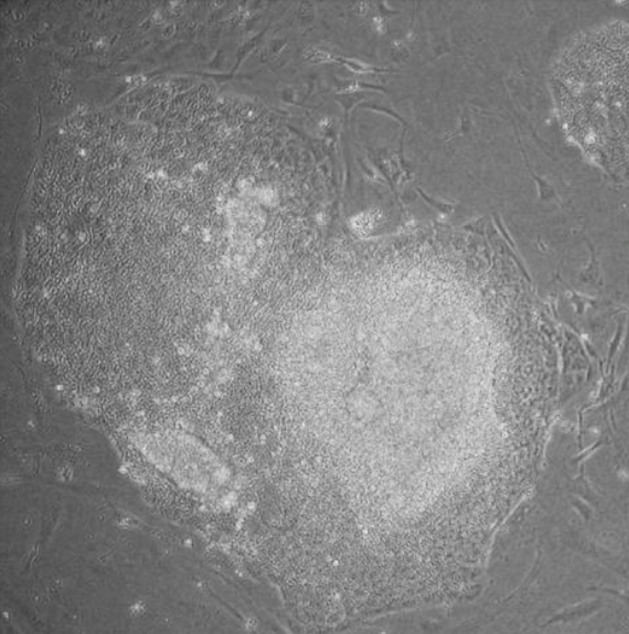
An iPSC line begins with an accessible somatic cell: a skin fibroblast, a peripheral blood mononuclear cell, or a renal epithelial cell shed into urine. The Yamanaka factors are introduced, and over two to four weeks a small fraction of the treated cells activate the endogenous pluripotency network and form colonies that can be picked, expanded and banked.1
Vector choice decides whether a line can ever reach a patient, so clinical derivation uses footprint-free methods: Sendai virus, episomal plasmids or synthetic mRNA, none of which leave a permanent trace in the genome. The effort then shifts from making the line to qualifying it, through karyotyping, copy-number analysis, sequencing for acquired mutations, and confirmation that no undifferentiated cells survive into the final product. Qualification rather than derivation is what makes a clinical-grade line expensive, a point that governs everything in the autologous debate below.
Reprogramming also resets the cell's methylation age. An iPSC line from an eighty-year-old reads as embryonic on the multi-tissue Epigenetic clocks that Steve Horvath built, which is the observation that launched Epigenetic reprogramming as a rejuvenation strategy.2 The reset does not extend to somatic mutations, which the donor cell carries forward. Deliberately stopping the process short of pluripotency, the technique known as Partial reprogramming, is the attempt to capture the epigenetic reset without producing a stem cell at all.
Compared with embryonic stem cells, iPSCs match closely in differentiation capacity but differ in provenance. They can be made from anyone, at any age, without an embryo, which removes the legal restrictions that constrain ESC work in several countries. Against that, each line carries the donor's accumulated somatic mutations and a residual epigenetic memory of the tissue it came from, and lines vary more between one another than well-characterised ESC lines do.
Development history
-
2006Mouse iPSCsTakahashi and Yamanaka reprogramme mouse fibroblasts with four transcription factors.
-
2007Human iPSCsTwo groups independently derive human iPSCs, one using the original four factors and one a partly different set.
-
2012Nobel PrizeShinya Yamanaka shares the prize with John Gurdon for showing that mature cells can be reprogrammed to pluripotency.
-
2014First patientA woman with neovascular macular degeneration receives a sheet of retinal pigment epithelium grown from her own reprogrammed cells at RIKEN in Japan.
-
2015–2017Autologous approach reconsideredA second planned transplant is cancelled after genomic changes are found in the prepared cells, and the programme shifts to banked, HLA-matched donor lines.
-
2024–2025First efficacy signalsSmall trials report transplants of iPSC-derived corneal epithelium, dopaminergic progenitors for Parkinson's disease, and reprogrammed-cell-derived islets in type 1 diabetes.
Uses in research
The largest impact so far is not therapeutic. iPSCs let a laboratory obtain living neurons, cardiomyocytes or hepatocytes carrying a specific patient's genome, which was previously impossible for most tissues. Disease modelling in patient-derived neurons is now standard in work on Parkinson's disease, amyotrophic lateral sclerosis and rare developmental disorders, particularly when combined with CRISPR–Cas9 to create isogenic controls differing only at the variant of interest.
They are also the starting material for most Organoids, for cardiac and hepatic toxicity screening in drug development, and for the differentiation protocols that Tissue engineering and Organ bioprinting depend on for cell supply. In reproductive biology, In vitro gametogenesis proceeds through an iPSC or ESC intermediate, and the stem-cell-based embryo models that have forced a rethink of the fourteen-day rule are assembled from pluripotent cells of either kind.
Large-scale panels have extended the approach to population genetics. Consortium collections of hundreds of donor lines allow a variant's effect on cell behaviour to be measured across many genetic backgrounds, which is closer to a controlled experiment in human genetics than anything previously available.
Clinical progress
The first human use came in 2014, when a Japanese woman in her seventies received a sheet of retinal pigment epithelium grown from her own reprogrammed skin cells for neovascular age-related macular degeneration. The graft survived and the disease stabilised, though vision did not improve.3 The programme subsequently moved to banked donor lines after genomic changes were detected in cells prepared for a second patient.
Progress since has been incremental and concentrated in Japan and China. A Kyoto University phase I/II trial transplanted iPSC-derived dopaminergic progenitors into the brains of a small number of people with Parkinson's disease, reporting in Nature in 2025 that the cells survived, produced dopamine, and caused no tumours, with motor improvement in some participants. A Japanese group reported transplanting iPSC-derived corneal epithelial sheets into patients with limbal stem cell deficiency. In 2024 a Chinese group reported that a woman with type 1 diabetes became insulin-independent after receiving islets differentiated from her own chemically reprogrammed cells. Cardiomyocyte patches for heart failure have been trialled in Japan.
Every one of these is a small, early-phase study. As of mid-2026 no iPSC-derived product has full marketing approval anywhere. Japan's conditional-approval pathway for regenerative medicines is often cited as the route by which a first approval could arrive, though that pathway has itself been criticised for licensing products on thin efficacy evidence.
Read the cell source carefullySeveral widely reported "stem cell" trials use embryonic stem cells rather than iPSCs, including prominent Parkinson's and type 1 diabetes programmes. The two behave similarly in the dish but differ entirely in supply chain, ethics and immune matching. Coverage frequently conflates them.
The autologous problem
The original appeal of iPSCs was a personalised line for every patient. That model has largely collapsed on cost and time. Deriving a clinical-grade line, qualifying it, differentiating it and releasing it takes months and has been estimated at hundreds of thousands of dollars per patient, which is unworkable for an acute indication and marginal even for a chronic one. It is a sharper version of the pricing problem described under Access and inequality and in Somatic gene therapy.
Two responses dominate. Haplobanking assembles lines from donors homozygous across the major HLA loci, so that a modest number of lines can immune-match a large fraction of a population; Japan's national iPSC stock is the furthest advanced. Hypoimmunogenic engineering goes further, knocking out MHC class I and class II presentation and adding a "don't eat me" signal such as CD47 so that a single universal line can be used in anyone.4 The second approach trades immune matching for the risk that the resulting cells are also invisible to immune surveillance of tumours.
Risks
Residual undifferentiated cells in a graft can form teratomas, which is why release criteria for iPSC products are stringent and why dose is limited. Culture-acquired mutations, particularly in TP53, can be selected for during expansion. Differentiation protocols rarely produce pure populations, and off-target cell types in a graft may behave unpredictably. Epigenetic memory of the donor cell type biases differentiation efficiency in ways that vary between lines.
None of these is unique to iPSCs, but the combination means that a line is not a commodity: two lines from the same donor can differ in behaviour, which complicates manufacturing more than the underlying biology suggests.
Outlook
The technology's near-term value remains in the dish, where it has already changed how human disease is studied. Cell therapy is advancing along the same route that most regenerative medicine takes: small, immune-privileged, structurally simple targets first, with the eye, the pancreas and the substantia nigra ahead of anything resembling a whole organ. Whether iPSC grafts eventually reduce the Organ shortage or remain a niche alongside Xenotransplantation depends on manufacturing economics at least as much as on biology.
See also
- Yamanaka factors
- Epigenetic reprogramming
- Organoids
- Tissue engineering
- Lab-grown organs
- Human cloning
- In vitro gametogenesis
- Shinya Yamanaka
References
Footnotes
-
paperTakahashi, K. et al. "Induction of Pluripotent Stem Cells from Adult Human Fibroblasts by Defined Factors." Cell, 2007. ↩
-
paperHorvath, S. "DNA methylation age of human tissues and cell types." Genome Biology, 2013.↩The clock was trained to predict chronological age, so a reset reading in reprogrammed cells is a change in a predictor rather than a demonstrated change in the cell.
-
paperMandai, M. et al. "Autologous Induced Stem-Cell-Derived Retinal Cells for Macular Degeneration." New England Journal of Medicine, 2017.↩A single treated patient; the reported outcome is graft survival and disease stabilisation, not improved vision.
-
paperDeuse, T. et al. "Hypoimmunogenic derivatives of induced pluripotent stem cells evade immune rejection in fully immunocompetent allogeneic recipients." Nature Biotechnology, 2019. ↩