Human germline editing is the deliberate alteration of DNA in gametes, zygotes, or early embryos such that the change is carried by every cell of the resulting person and passed to their children. It is the practice that separates genetic medicine from genetic inheritance. Almost every scientific body that has examined it has concluded that clinical use is not currently justified, and it has been attempted in a clinic exactly once, in 2018, by a researcher subsequently imprisoned in China.
Definition and scope
The germ line is the cell lineage that produces eggs and sperm. Edits made anywhere else — in liver, muscle, blood, retina — die with the patient, which is why Somatic gene therapy is regulated as ordinary medicine and heritable editing is not regulated as medicine at all in most countries but prohibited outright.
The boundary is less crisp than the vocabulary suggests. Editing spermatogonial stem cells in an adult man is technically somatic but heritable in effect. Mitochondrial replacement therapy, legal in the United Kingdom since 2015 and used there in births reported in 2025, alters the mitochondrial genome transmitted down the maternal line; it is heritable, yet it was legislated as an exception rather than treated as germline modification, on the argument that it swaps an organelle rather than editing nuclear DNA. Whether that distinction is principled or convenient remains disputed.
Two further clarifications matter. Germline editing is not embryo selection. Selection chooses among embryos that already exist and cannot introduce a variant that no embryo has; Embryo selection and Polygenic embryo screening work entirely within the range of what a given couple's gametes happen to produce. Editing writes something new. And germline editing is not cloning: Human cloning copies a genome, whereas editing changes one.
TerminologyScientific bodies increasingly prefer "heritable human genome editing" to "germline editing", because the term names the consequence — inheritance by descendants — rather than the tissue, and so covers edge cases like gamete precursor cells and mitochondrial transfer.
How it would be done
The procedure would sit inside a standard IVF cycle. Eggs are retrieved and fertilised; the editing reagents — most plausibly a CRISPR–Cas9 ribonucleoprotein, a Base editing complex, or a Prime editing system, the last two avoiding the double-strand break that a nuclease necessarily makes — are introduced into the zygote by microinjection or electroporation, ideally at or before fertilisation so that editing precedes the first cell division. The embryo is cultured for several days, a few trophectoderm cells are biopsied and sequenced, and an embryo judged correctly edited is transferred.
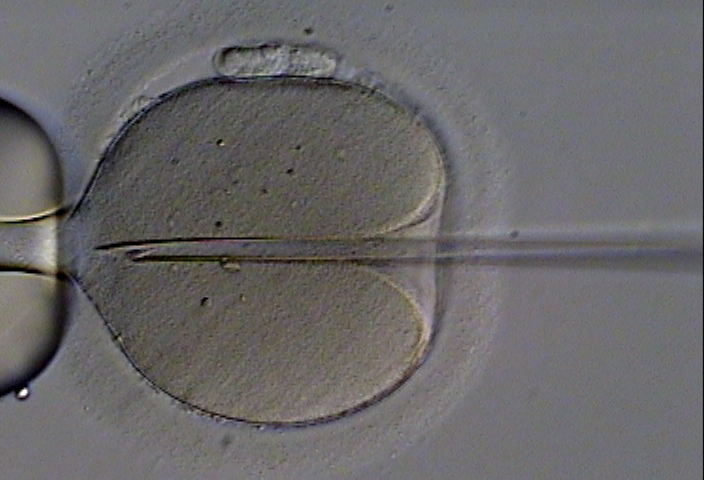
Every step of that description contains an unsolved problem, and the biopsy step contains the deepest one.
An alternative entry point would avoid several of them. Editing gamete precursor cells — spermatogonial stem cells in a testis, or oocyte precursors derived in culture — allows the edited cell population to be expanded, sequenced exhaustively, and selected before any embryo exists. Nothing would then be mosaic, and verification would no longer destroy the thing verified. Human spermatogonial culture is difficult and human oogenesis in vitro has not been achieved, so this route remains theoretical; it is nonetheless the version of heritable editing that has the fewest intrinsic technical objections, and it is the one that In vitro gametogenesis research would make possible if it succeeds.
Technical obstacles
Mosaicism
Editing reagents remain active after the zygote divides. If the first cut occurs at the two- or four-cell stage, the resulting embryo is a mixture of edited, unedited, and differently edited cells. A biopsy samples five to ten cells from the trophectoderm — tissue that becomes placenta, not fetus — and so provides a sample of a mosaic, not a description of the child. Injecting reagents earlier reduces but does not abolish the problem.
On-target damage
Attention initially focused on off-target cuts at similar sequences elsewhere in the genome. The more serious finding, reported in human embryos in 2020 and 2021, was damage at the intended site: large deletions, loss of heterozygosity across whole chromosome arms, and outright loss of the targeted chromosome.12 Standard short-read sequencing of a biopsy can miss all of these, because a deleted allele simply fails to amplify and reads as homozygous for the remaining one.
Verification is destructive
This is the structural obstacle, not merely a current limitation. The only way to characterise an embryo's genome completely is to disaggregate and sequence it, which destroys it. Any transferred embryo is therefore certified by inference from a biopsy of different cells. In somatic therapy an edited cell product can be sequenced exhaustively before infusion; the germline case forecloses that option permanently.
The animal evidence is not reassuring
Editing has been performed in non-human primate embryos since 2014, when Cas9-modified cynomolgus monkeys were born carrying targeted mutations.3 The offspring were mosaic. A decade of subsequent primate work has not produced a protocol that reliably yields uniformly edited, chromosomally intact animals, and the primate colonies involved are small enough that rare adverse outcomes would be hard to detect. Any claim that embryo editing is nearly ready for human use has to explain why the species closest to humans has not yet demonstrated it.
The claim that has already collapsed once
A 2017 report claimed that human embryos repaired an inherited cardiomyopathy mutation by copying the healthy maternal allele, which if true would have offered a template-free route to correction.4 Other groups argued the apparent correction was more likely allele dropout — the mutant allele deleted and therefore invisible — and the interpretation was contested in the literature.5 The episode is a standing reminder that embryo genotyping is unusually easy to get wrong.
ContestedNo published work demonstrates accurate, complete, non-mosaic editing of a human embryo verified to the standard that clinical use would require. The 2020 international commission treated establishing such a demonstration as a precondition even to begin discussing translation.6
When editing would beat selection
The strongest argument against germline editing is not that it is dangerous but that it is usually unnecessary. For nearly every couple at risk of transmitting a serious monogenic condition, preimplantation genetic testing identifies an unaffected embryo among those already produced. Editing adds risk without adding capability.
The 2020 report of the International Commission convened by the US National Academies and the UK Royal Society identified the residual cases. They are few:
- Both prospective parents homozygous for the same recessive condition — for example both living with sickle cell disease — so that every embryo they can produce is affected.
- One parent homozygous for a dominant condition, a rare situation in disorders such as Huntington's disease.
- Couples for whom testing is possible in principle but who reliably obtain very few embryos, or none unaffected, across repeated cycles.
The number of couples worldwide in these categories is small, and each of them already has alternatives: donor gametes, adoption, or accepting the risk and treating the child if it materialises. Whether those alternatives count as acceptable substitutes for a genetically related unaffected child is exactly what the argument turns on. Two developments would shrink the residual set further. In vitro gametogenesis, if it worked in humans, would generate large numbers of embryos and make selection far more powerful, and treatments delivered after birth are advancing: conditions once regarded as untreatable, sickle cell disease among them, now have approved therapies such as Casgevy.
Governance and law
-
2015First CRISPR in human embryosA Chinese group reports editing non-viable tripronuclear zygotes, finding low efficiency, extensive mosaicism, and off-target cuts.
-
2015First International SummitMeeting in Washington, DC, the organising committee calls clinical germline use irresponsible until safety is resolved and there is broad societal consensus.
-
2016First research licenceThe UK Human Fertilisation and Embryology Authority licenses Kathy Niakan's laboratory to edit human embryos for research into early development.
-
2018Edited twinsThe birth of twin girls with edited CCR5 genes is announced in Shenzhen days before the Second Summit convenes in Hong Kong.
-
2020Commission reportAn international commission convened by the US National Academies and the Royal Society defines preconditions and a narrow set of possible first uses.
-
2021Framework and fresh warningsThe WHO publishes a governance framework and recommendations for genome editing; following a 2020 report of chromosome loss, another group reports frequent loss of heterozygosity in edited human embryos.
-
2023Third SummitMeeting in London, the summit concludes that heritable editing remains unacceptable and turns much of its attention to the unequal reach of somatic therapies.
-
2025Private venturesReports of privately funded US companies pursuing heritable editing prompt professional societies to call jointly for an extended moratorium on clinical use.
Wherever the question is regulated at all, the law splits at the moment of transfer. Editing embryos in a dish is permitted, under licence or under guidelines, in the United Kingdom, China, Japan, and the United States; placing an edited embryo in a uterus is what is forbidden. Research embryos are separately bound by the fourteen-day culture limit that most jurisdictions and professional guidelines impose, which ends every experiment long before any developmental consequence of an edit could be seen. The evidence base is therefore capped by law at the first fortnight of development, for a technology whose consequences would play out over a lifetime and beyond it.
The instruments doing the forbidding differ in strength, and that variation matters more than the headline count of countries. Some are criminal statutes with stated penalties. Others are clauses in assisted-reproduction acts drafted before editing existed, ministry guidelines with no sanction attached, or — as in the United States — an appropriations rider that bars the Food and Drug Administration from acknowledging an application involving a heritable modification, closing the licensing route without creating any offence. A country can appear on a list of jurisdictions that prohibit heritable editing while having nothing a prosecutor could actually charge.7 The instrument-by-instrument picture, and the treaties that sit above it, are set out in Governance of human genome editing.
Professional self-governance has done the rest of the work: the 2015 commentary in which Jennifer Doudna and co-authors urged that clinical germline use be discouraged while the research questions were settled,8 then the three international summits, the academies' reports, and the World Health Organization's 2021 recommendations, which ask member states to treat clinical germline use as prohibited and establish a registry for genome-editing research.9 Its instruments are soft: statements, licensing conditions, funder policies, journal refusals. None carries enforcement power. On the one occasion the line was crossed, every consequence came from a Chinese criminal court applying a statute about practising medicine without a licence, which had nothing to do with genetics.
The disagreement about pathwaysOne camp holds that defining a translational pathway is the responsible response, because a route that is legal, licensed, and monitored is safer than a prohibition that pushes work into unregulated clinics. The other holds that specifying a pathway is itself a form of endorsement that makes eventual use likelier, and points to the Asilomar Conference on Recombinant DNA precedent, where a self-imposed moratorium was lifted once containment measures were agreed.
Enhancement and outlook
The slope argument
Nothing in the technique distinguishes correcting a disease allele from installing an advantageous one. The 2018 case is the empirical data point: the twins had no disease, and the edit was intended to confer resistance to an infection they might never encounter — prophylaxis or enhancement, not treatment. Critics of a therapeutic pathway argue that the same clinics, techniques, and consent forms would carry enhancement requests, and that the demand exists whether or not the science supports it.
The science mostly does not. Variants with large, well-understood, unambiguously beneficial effects are rare; most traits people would want to change are influenced by thousands of variants of tiny effect, so Genetic enhancement of cognition by editing is not a near-term prospect regardless of legality. Even apparently simple protective variants carry pleiotropic costs: disrupting CCR5 confers partial HIV resistance and also increases susceptibility to West Nile virus. The realistic near-term enhancement worry is not superhuman children but confident intervention on the basis of incomplete genetics, an error mode that Designer babies discussions frequently understate and that ethicists working on Procreative beneficence and Disability rights and enhancement have examined from opposite directions.
What would have to change
For heritable editing to become defensible, several things would each have to be true: editing in embryos would need to be demonstrably complete and non-mosaic; verification would need a method that does not destroy what it certifies; the multigenerational consequences would need an evidence base that by definition takes generations to build; and there would need to be a category of prospective parents for whom no alternative route to a healthy genetically related child exists. None of these is close as of 2026, and the last is shrinking rather than growing.
The pressure is nevertheless increasing from an unexpected direction. Press reports in 2025 described privately funded ventures in the United States openly pursuing heritable editing outside the academic system, prompting professional societies in gene therapy and reproductive medicine to call jointly for an extended moratorium on clinical use. Private capital is not bound by funder policies, journal norms, or the informal disciplines that have governed the field since 2018. The open question is therefore less whether the science becomes ready than whether the institutions that have held the line have any purchase on actors who never belonged to them.
See also
- He Jiankui affair
- Governance of human genome editing
- CRISPR–Cas9
- Embryo selection
- Polygenic embryo screening
- Somatic gene therapy
- Designer babies
- Bioethics of enhancement
References
Footnotes
-
paperZuccaro, M.V. et al. "Allele-specific chromosome removal after Cas9 cleavage in human embryos." Cell, 2020.↩Human research embryos, never transferred; the losses were found only with assays designed to catch allele dropout.
-
paperAlanis-Lobato, G. et al. "Frequent loss of heterozygosity in CRISPR-Cas9-edited early human embryos." Proceedings of the National Academy of Sciences, 2021. ↩
-
paperNiu, Y. et al. "Generation of Gene-Modified Cynomolgus Monkey via Cas9/RNA-Mediated Gene Targeting in One-Cell Embryos." Cell, 2014. ↩
-
paperMa, H. et al. "Correction of a pathogenic gene mutation in human embryos." Nature, 2017. ↩
-
paperEgli, D. et al. "Inter-homologue repair in fertilized human eggs?" Nature, 2018. ↩
-
reportInternational Commission on the Clinical Use of Human Germline Genome Editing. Heritable Human Genome Editing. US National Academy of Medicine, National Academy of Sciences, and the Royal Society, 2020.↩Convened by academies rather than by a regulator; it sets preconditions for a possible future use and endorses none.
-
paperBaylis, F., Darnovsky, M., Hasson, K., Krahn, T.M. "Human Germline and Heritable Genome Editing: The Global Policy Landscape." The CRISPR Journal, 2020.↩A survey of policy instruments rather than of practice; the instruments it counts range from criminal statutes to guidelines with no sanction attached.
-
paperBaltimore, D. et al. "A prudent path forward for genomic engineering and germline gene modification." Science, 2015.↩A commentary by the participants of a small meeting in Napa, California, urging that clinical germline use be discouraged while research continued; it carried no legal force.
-
reportWorld Health Organization. Human Genome Editing: A Framework for Governance and Recommendations. WHO, 2021.↩Recommendations addressed to member states. The WHO cannot prohibit anything, and the research registry it proposes is voluntary.