Loading
Old version — revision 1
This is a fixed snapshot of CRISPR–Cas9, saved by Import as part of the initial corpus import. It is not edited and it is not updated; the article may have changed since.
Edit summary: Initial import of content/crispr-cas9.md — the filesystem corpus, unchanged. Not an edit.
CRISPR–Cas9
A bacterial defence system repurposed as a programmable DNA-cutting tool, in which a short guide RNA directs the Cas9 enzyme to a chosen sequence in almost any genome.
TechnologyEstablishedpresentTRL 9revision 1
17.4 kB1,763 wordsGeneticsfrontmatter date 2026-07-27
CRISPR–Cas9 is a two-part molecular machine — a short guide RNA and a DNA-cutting protein — that bacteria use to destroy invading viral genomes and that biologists have repurposed to cut a chosen sequence in almost any organism. Its advantage over earlier editing platforms is that the target is specified by an interchangeable twenty-nucleotide RNA rather than by a redesigned protein, so retargeting takes days instead of months. Cutting, however, is only the first step. What an edit becomes depends on how the cell repairs the break, and that repair is the part biologists control least.
Origins in bacterial immunity
The sequences now called CRISPR — clustered regularly interspaced short palindromic repeats — were first noticed in 1987 by Yoshizumi Ishino's group at Osaka University, who found an odd series of repeats downstream of a gene they were sequencing for unrelated reasons and could not explain them.1 Through the 1990s and early 2000s the same architecture turned up in many bacteria and archaea. Francisco Mojica at the University of Alicante catalogued the arrays, coined the acronym with Ruud Jansen, and proposed that the sequences between the repeats, called spacers, matched viral and plasmid DNA, implying an adaptive immune function.
-
1987Repeats observedIshino's group at Osaka University reports unusual repeated sequences in Escherichia coli while sequencing an unrelated gene. Their function is unknown.
-
2005Spacers matched to virusesMojica and, independently, other groups notice that CRISPR spacers correspond to phage and plasmid sequences, suggesting an immune role.
-
2007Immunity demonstratedBarrangou and colleagues at Danisco show experimentally that Streptococcus thermophilus acquires new spacers after phage challenge and becomes resistant.
-
2011tracrRNA identifiedCharpentier's group finds a second small RNA required for CRISPR RNA maturation in the type II system, completing the picture of the Cas9 machinery.
-
2012Programmable cleavageJinek and colleagues show Cas9 can be aimed at a chosen DNA sequence and that its two natural RNAs can be fused into one engineered guide; Gasiunas and colleagues independently report the same cleavage biochemistry.
-
2013Editing in human cellsGroups led by Zhang, Church and others adapt the system to mammalian cells within months of the 2012 papers.
-
2020Nobel PrizeCharpentier and Doudna share the Nobel Prize in Chemistry for the development of a method for genome editing.
The experimental proof came in 2007, when Rodolphe Barrangou, Philippe Horvath and colleagues at the food-ingredients company Danisco challenged Streptococcus thermophilus with bacteriophage and showed that surviving bacteria had incorporated fragments of the phage genome into their CRISPR array and become resistant.2 Subsequent work established that the arrays are transcribed and processed into short CRISPR RNAs, and that these guide Cas proteins to matching DNA.
The step that made the system a tool came in 2012. Martin Jinek, Krzysztof Chylinski, Jennifer Doudna, Emmanuelle Charpentier and co-workers showed that the type II protein Cas9 is a dual-RNA-guided endonuclease, that its two RNAs could be fused into a single chimeric guide, and that changing twenty nucleotides of that guide redirected cleavage to a new sequence.3 Virginijus Šikšnys's group published closely related biochemistry the same year.4 Within a year, several laboratories had the system cutting in human and mouse cells.56
How it works
The system has two jobs that are worth separating, because they fail in different ways. The first is finding one twenty-base address in a genome of three billion. The second is doing something useful once it arrives. Cas9 performs the first job well and the second not at all: it makes a break and leaves the consequences to the cell.
Targeting
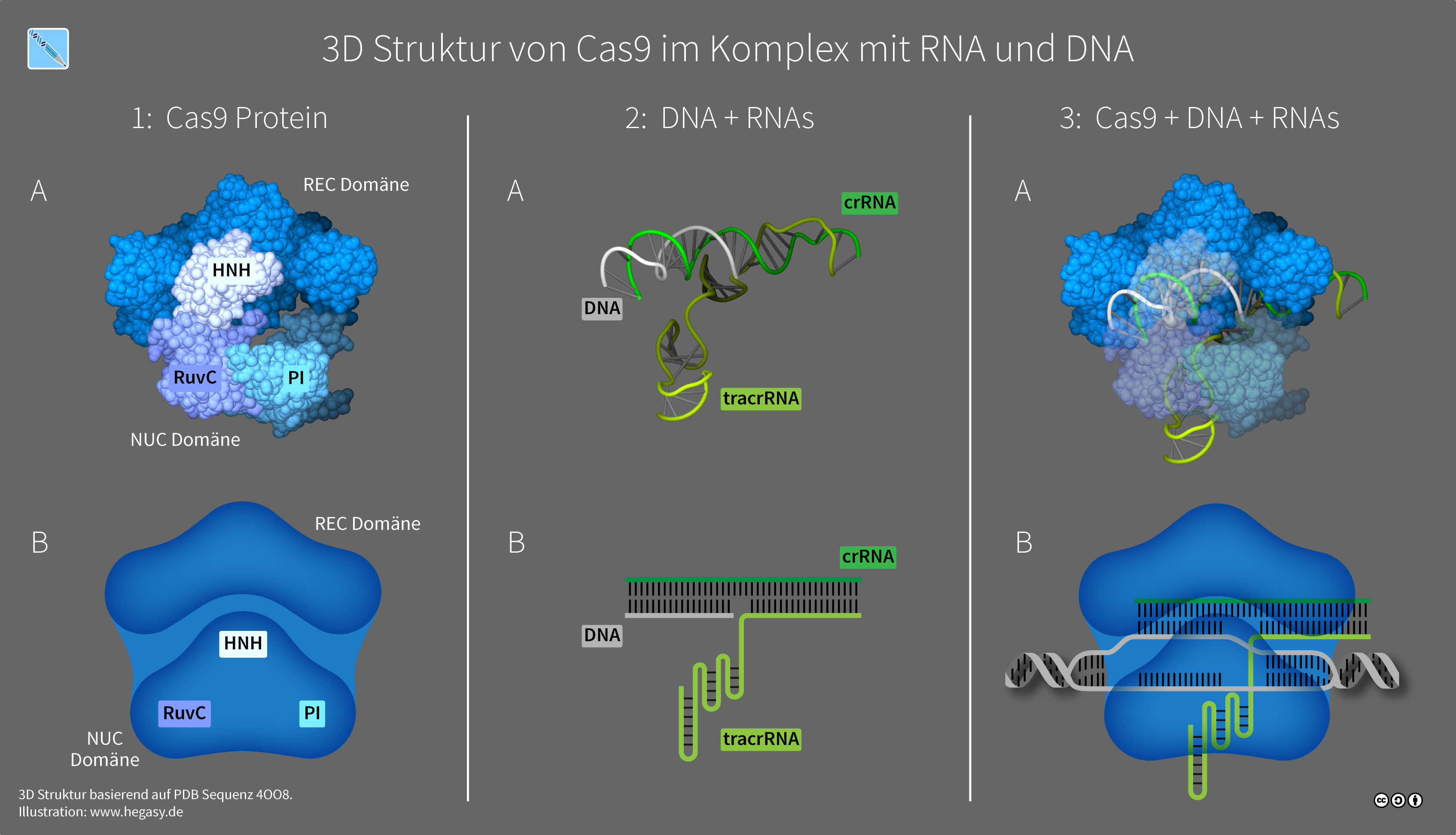
The guide RNA carries a spacer of roughly twenty nucleotides complementary to the intended target. Cas9 does not scan the genome by reading that sequence directly. It first searches for a short motif adjacent to the target called the protospacer adjacent motif, or PAM — for the commonly used Streptococcus pyogenes enzyme, the three bases 5'-NGG-3'. Only after binding a PAM does Cas9 locally unwind the double helix and test whether the guide RNA can pair with the adjacent strand. A match holds the complex in place and triggers a conformational change that activates the enzyme; a mismatch lets it release and continue searching.
This two-stage check explains both the specificity and the limits of the system. The PAM requirement means not every site in a genome is addressable, though engineered variants with relaxed PAM preferences have widened the accessible fraction considerably. It also explains why mismatches distant from the PAM are tolerated more often than mismatches close to it, which is the root of most off-target activity.
Cutting and repair
Cas9 has two nuclease domains, HNH and RuvC, which cut the two DNA strands to leave a blunt double-strand break a few base pairs from the PAM. The cell then repairs it, and the repair pathway determines the outcome. Non-homologous end joining and related pathways rejoin the ends directly and frequently insert or delete a few bases, which shifts the reading frame and disables the gene. This is the easy, high-efficiency outcome, and it is why CRISPR is far better at breaking genes than at fixing them.
Precise replacement requires homology-directed repair, which copies a supplied template. HDR operates mainly in dividing cells during S and G2 phase, competes poorly against end joining, and is inefficient in the post-mitotic cells that matter most in the nervous system, heart and muscle. Much of the field's subsequent engineering — Base editing, Prime editing and Epigenome editing — exists to get useful changes without depending on a double-strand break at all.
Why the break mattersA double-strand break is a genuine chromosomal injury. The cell's response to it, not the nuclease, produces the edit — which is why the same guide RNA can give clean knockout in one cell type and a mixture of deletions, inversions and unedited alleles in another.
Adaptation and the wider toolbox
The Cas9 protein from S. pyogenes is about 1,360 amino acids, and its coding sequence sits uncomfortably close to the roughly 4.7 kilobase packaging limit of adeno-associated viral vectors. Compact orthologues such as the Staphylococcus aureus enzyme were adopted partly for that reason. Other CRISPR effectors have distinct properties: Cas12a recognises T-rich PAMs and leaves staggered cuts, while Cas13 targets RNA rather than DNA and underpins several diagnostic assays. Sequence models have begun to generate Cas nuclease variants that were not found in any bacterium, an application of AI protein design to the editing toolkit itself. Catalytically dead Cas9, with both nuclease domains disabled, retains its RNA-programmed DNA binding and became the docking module for the transcriptional and epigenetic tools described elsewhere on this wiki.
Delivery, not cutting, is the practical constraint. Ex vivo work usually electroporates a preassembled Cas9–guide ribonucleoprotein into cells outside the body, where dosing is controlled and the protein degrades within hours. In vivo work depends on Lipid nanoparticles or viral vectors, and inherits their tropism: nanoparticles reach hepatocytes easily and other tissues with difficulty.
Current state
As of 2026 the technology is routine in research and has begun to produce approved medicine. Casgevy, an ex vivo therapy that disrupts an enhancer of BCL11A in a patient's own blood stem cells to raise fetal haemoglobin, was authorised in the United Kingdom and United States across late 2023 and early 2024 for sickle cell disease and transfusion-dependent beta thalassemia; it was the first approved CRISPR medicine anywhere.7 In vivo editing has also reached patients: a lipid-nanoparticle-delivered Cas9 targeting the TTR gene in the liver produced durable reductions in the disease-causing protein in transthyretin amyloidosis.8
Beyond human therapy, Cas9 is standard equipment for making animal models, for genome-wide knockout screens, for engineering donor pigs in Xenotransplantation, for the edited proxy species pursued under the banner of De-extinction, and for the population-scale constructs described under gene drives. Crops edited rather than transgenically modified have reached market in several jurisdictions under regulatory regimes that treat small deletions differently from inserted foreign DNA.
Limitations
Efficiency varies enormously by cell type, target site and delivery route, and the number reported in a paper is usually the best of several guides in a permissive cell line. Precise correction remains hard in non-dividing tissue. Editing is stochastic across a cell population, so a treated tissue is a mosaic of edited and unedited cells, and for many conditions nobody knows what fraction must be corrected to matter clinically.
Measurement is a limitation in its own right. Editing is usually reported as the percentage of sequencing reads carrying an indel at the target, a figure that says nothing about how those edits are distributed. The same aggregate number can describe a population in which most cells carry one disrupted allele and one intact one, or a smaller population of fully edited cells among untouched neighbours, and for a recessive condition the two are clinically very different. Amplicon sequencing also cannot see alleles it fails to amplify, so the rearrangements described below are systematically undercounted by the assay used to declare success.
Immunology imposes another constraint. Because both S. pyogenes and S. aureus are common human pathogens, a substantial share of people carry pre-existing antibodies and T cells against the corresponding Cas9 proteins, which complicates repeat in vivo dosing.9
Risks
The best-characterised hazards are genomic. Guides can cut at sequences resembling the target, and the resulting edits are unintended and permanent. On-target damage is arguably the larger problem: repair of a Cas9 break can produce kilobase-scale deletions, inversions and complex rearrangements that short-amplicon sequencing does not detect.10 Breaks can also trigger a p53-mediated damage response, which selects against successfully edited cells and, in principle, for cells with impaired p53.
The governance questions differ sharply between somatic and heritable use. Somatic gene therapy affects only the treated person and is regulated as medicine. Heritable editing passes changes to descendants, cannot be consented to by the person affected, and after the He Jiankui affair of 2018 is prohibited or unapproved in essentially every country with a relevant law — a situation examined in Governance of human genome editing. The ease of the technique also makes it a standing example in debates over Dual-use research of concern, where the self-governance model of the Asilomar Conference on Recombinant DNA is repeatedly invoked and repeatedly disputed.
ContestedClaims that CRISPR is "precise" describe the targeting step, not the outcome. Guide binding is specific; the repair that follows is not, and characterising on-target rearrangements requires long-read or single-cell sequencing that many published studies did not perform.
The patent dispute
Ownership of the eukaryotic application has been litigated for more than a decade. The University of California, the University of Vienna and Charpentier filed first; the Broad Institute filed later and obtained early grants through accelerated examination. United States interference proceedings turned on who first conceived a working system in eukaryotic cells, and in 2022 the Patent Trial and Appeal Board awarded priority to the Broad. On appeal in 2025 the Federal Circuit vacated that decision and returned the case to the board, so the American position remains unsettled as of 2026. European outcomes have differed, partly on procedural grounds relating to priority claims. The 2020 Nobel Prize in Chemistry to Charpentier and Doudna, which omitted Feng Zhang and George Church among others, drew comment precisely because it did not track the patent fight.
Outlook
Cas9 is now the least interesting part of the problem. The active frontier is delivery to tissues other than liver and blood, editors that write rather than break, and the regulatory question of how to evaluate a therapy manufactured for one patient. Efforts to reduce the cost of bespoke editing bear on whether the technology narrows or widens existing inequities in access. Whether cutting-based editing remains the dominant approach at all is genuinely open: for many indications, a tool that changes one base or silences a gene without severing a chromosome may prove both safer and easier to approve.
See also
- Base editing
- Prime editing
- Off-target effects in genome editing
- Casgevy
- Human germline editing
- Jennifer Doudna
- Gene drives
- Governance of human genome editing
References
Footnotes
-
paperIshino, Y., Shinagawa, H., Makino, K., Amemura, M., Nakata, A. "Nucleotide sequence of the iap gene, responsible for alkaline phosphatase isozyme conversion in Escherichia coli, and identification of the gene product." Journal of Bacteriology, 1987. ↩
-
paperBarrangou, R. et al. "CRISPR provides acquired resistance against viruses in prokaryotes." Science, 2007. ↩
-
paperJinek, M., Chylinski, K., Fonfara, I., Hauer, M., Doudna, J. A., Charpentier, E. "A programmable dual-RNA-guided DNA endonuclease in adaptive bacterial immunity." Science, 2012. ↩
-
paperGasiunas, G., Barrangou, R., Horvath, P., Šikšnys, V. "Cas9–crRNA ribonucleoprotein complex mediates specific DNA cleavage for adaptive immunity in bacteria." Proceedings of the National Academy of Sciences, 2012. ↩
-
paperCong, L. et al. "Multiplex genome engineering using CRISPR/Cas systems." Science, 2013. ↩
-
paperMali, P. et al. "RNA-guided human genome engineering via Cas9." Science, 2013. ↩
-
paperFrangoul, H. et al. "CRISPR-Cas9 gene editing for sickle cell disease and β-thalassemia." New England Journal of Medicine, 2021.↩An early report on the first two patients, one with each disease, rather than the pivotal trial result.
-
paperGillmore, J. D. et al. "CRISPR-Cas9 in vivo gene editing for transthyretin amyloidosis." New England Journal of Medicine, 2021.↩A small first-in-human dose-escalation report; the endpoint was serum transthyretin concentration, not any clinical outcome.
-
paperCharlesworth, C. T. et al. "Identification of preexisting adaptive immunity to Cas9 proteins in humans." Nature Medicine, 2019.↩Antibodies and T cells were measured in blood from healthy donors; whether they cause harm in a treated patient was not tested.
-
paperKosicki, M., Tomberg, K., Bradley, A. "Repair of double-strand breaks induced by CRISPR–Cas9 leads to large deletions and complex rearrangements." Nature Biotechnology, 2018.↩The large deletions were visible only because the authors used long-range assays; standard short-amplicon sequencing does not detect them.