Artificial womb is the common name for a device that supports a fetus outside a pregnant body by connecting it to an external oxygenator through the umbilical vessels while it remains submerged in a fluid environment. Every system built so far is designed for partial ectogenesis: it takes over from a pregnancy already underway, at the edge of viability, and aims to carry the fetus a few more weeks. No device has gestated a mammal from conception, and none has been used in a human. The distinction between continuing a pregnancy and replacing one is the single most important thing about the technology and the thing most often lost in coverage of it.
How it works
The design problem is that a fetal lung is not a lung yet. Below roughly 26 weeks of human gestation the alveoli are too few and too thick-walled for gas exchange, and mechanical ventilation of such a lung causes the chronic injury known as bronchopulmonary dysplasia. Conventional neonatal intensive care manages this trade-off; an artificial womb tries to avoid it by never asking the lung to breathe.
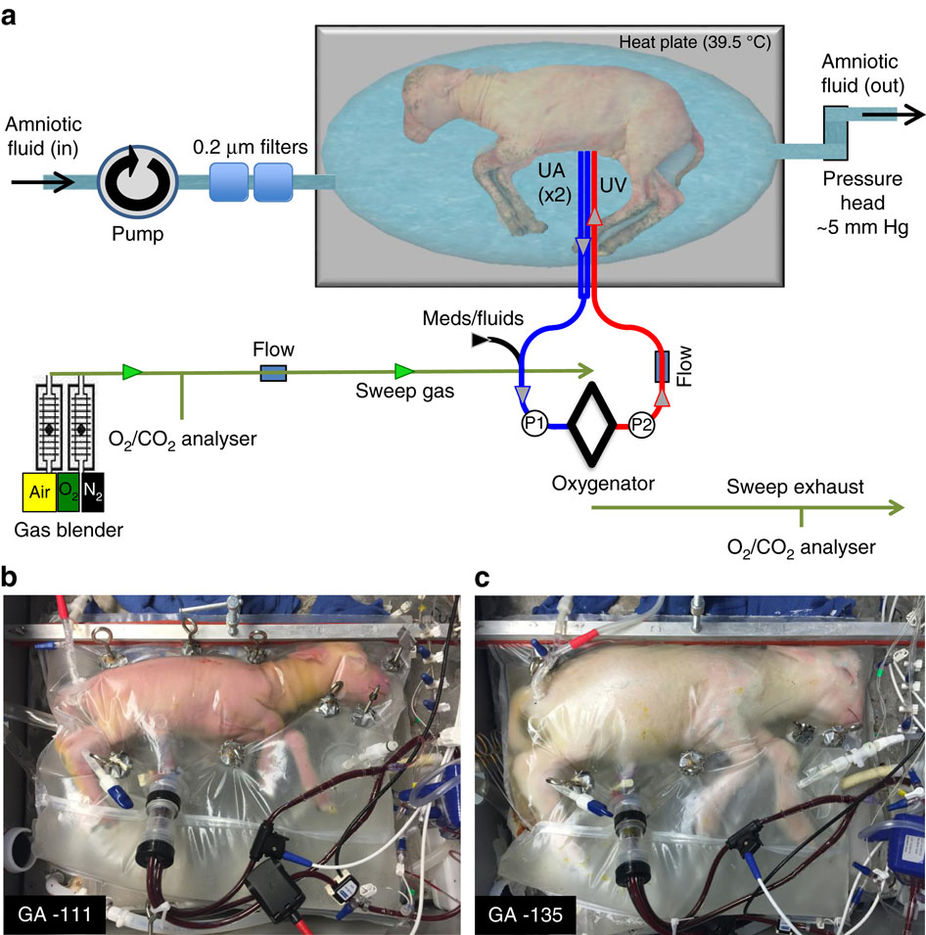
Four features distinguish the current systems from an incubator:
- Umbilical cannulation. Blood is drawn from and returned to the umbilical vein and arteries, preserving fetal circulation with its right-to-left shunts through the ductus arteriosus and foramen ovale. Neck or chest cannulation, as used in standard extracorporeal membrane oxygenation, disturbs that pattern.
- A pumpless circuit. In the Children's Hospital of Philadelphia design, the fetal heart alone drives blood through a low-resistance membrane oxygenator. Removing the pump removes a major source of haemolysis and of pressure injury to a fetal heart that cannot tolerate afterload.
- Fluid immersion. The fetus floats in a sterile, circulating fluid resembling amniotic fluid, which it swallows and which fills the lungs. Fluid distension is part of normal lung growth; air is not.
- A closed, sterile bag. The enclosure excludes light, handling, and airborne organisms, addressing infection as a leading cause of death in extremely preterm infants.
Oxygenation is titrated to fetal rather than neonatal targets, which are much lower than adult values, and it relies on the fetus's own haemoglobin rather than any oxygen-carrying substitute. Nutrition is delivered parenterally. The circuit is, in engineering terms, a carefully tuned variant of extracorporeal life support, closer to a mechanical circulatory support problem than to anything in reproductive medicine.
Development history
-
1923The word is coinedJ. B. S. Haldane proposes 'ectogenesis' in Daedalus, imagining gestation moved wholly outside the body.
-
1950s–1960sFirst perfusion attemptsResearchers including Robert Goodlin perfuse previable human fetuses in pressurised oxygenated fluid. Survival is measured in hours and the work draws lasting ethical criticism.
-
1980s–1990sGoat fetuses in TokyoYoshinori Kuwabara's group maintains goat fetuses in an extrauterine incubation system for up to several weeks, but with poor neurological outcomes and dependence on paralysis and sedation.
-
2017The biobagA Philadelphia team reports eight preterm lambs supported for up to four weeks with normal growth, lung maturation and myelination.
-
2019–2024Parallel programmesThe EVE platform in Australia and Japan and a European perinatal life support consortium pursue related designs; CHOP's work is commercialised through Vitara Biomedical.
-
2023Regulators take it upThe US Food and Drug Administration convenes its Pediatric Advisory Committee to discuss what evidence a first-in-human trial would require.
The modern line begins with the 2017 lamb study from Alan Flake's group at the Children's Hospital of Philadelphia.1 Lambs were delivered at 105 to 120 days of gestation, physiologically comparable to about 23 or 24 human weeks, cannulated through the umbilical cord, and placed in a polyethylene bag of circulating fluid. They grew, laid down wool, opened their eyes, and showed lung and brain development approaching that of age-matched controls. The system was named EXTEND, for Extra-uterine Environment for Neonatal Development.
Two other groups have reached comparable results in sheep. The EVE platform, developed by an Australian and Japanese collaboration, has focused on fetuses compromised by intrauterine inflammation, a common precipitant of preterm birth. A European consortium centred on Eindhoven has worked on a design intended to be filled and used in a delivery room, and has built high-fidelity manikins to train the cannulation, which must be done within minutes of delivery.
Earlier work matters mainly as a warning. Kuwabara's goat experiments in Tokyo achieved long survival but the animals were sedated and paralysed throughout, could not be weaned, and showed signs of neurological injury. The 1960s human perfusion experiments, conducted on previable fetuses obtained after abortion, produced no survivors and are now cited chiefly in discussions of research ethics.2
Current state
As of 2026 no human has been supported by an artificial womb, and no clinical trial has been publicly reported as having enrolled a participant. On the standard readiness scale the leading systems sit at validation in a relevant environment: they work reliably in a large-animal model that resembles the intended use but is not it. The FDA's 2023 advisory meeting did not authorise a trial; it aired the questions a sponsor would have to answer, and those questions turned out to be harder than the engineering.3
The central one is comparison. The intended population is infants born at 22 to 24 weeks, where outcomes vary enormously between centres and where the decision to resuscitate at all is a matter of parental choice and institutional policy. A trial would have to randomise between the device and active neonatal intensive care at a moment of crisis, obtain consent from parents in the middle of a preterm delivery, and define success in terms of long-term neurodevelopment rather than survival to discharge. Committee members also raised the problem of how a device tested in lambs translates to a human fetus whose brain development is on a different schedule, and how a failed cannulation would be handled.
The technology's regulatory identity is itself unsettled. It is a medical device, but one whose subject may not have legal personhood under the law of the jurisdiction where it is used, and whose status is different again if it is delivered by caesarean specifically to be placed in the device. The legal scholar Elizabeth Chloe Romanis has proposed the term "gestateling" for an entity that is neither fetus nor neonate because it is neither gestating in a body nor breathing air; the term has no statutory standing anywhere.
What the lamb studies do not showNormal growth and myelination in a lamb over four weeks is not evidence of normal human neurodevelopment over the years in which it would be measured. Sheep are precocial, with a shorter gestation and a differently timed brain growth spurt, and the lambs in these studies were euthanised at the end of support rather than followed to adulthood.
Complete ectogenesis
Gestating a human from fertilisation to term outside a body — complete ectogenesis, in the vocabulary set out in Ectogenesis — is a different technical problem, not a longer version of the same one. The unsolved parts are at the beginning, not the end. The only established way for someone without a functioning uterus to carry a pregnancy runs in the opposite direction: Uterus transplantation moves the organ into the patient rather than the fetus into a machine.
Implantation and placentation involve an invasive, immunologically negotiated interaction between trophoblast and maternal endometrium that no device reproduces. Trophoblast organoids grown from placental tissue reproduce part of the fetal side of that exchange in a dish, and endometrial cultures reproduce part of the maternal side, but nobody has assembled a functioning placenta from either. Culture systems have made progress at both ends of the gap and none in the middle. Human embryos are routinely cultured to the blastocyst stage for Embryo selection, and research protocols have extended culture to around the fourteen-day limit that governs such work in most jurisdictions. At the other end, the artificial womb handles the last trimester in animals. Between roughly two weeks and twenty-two weeks lies the entire process of placental development, organogenesis, and the endocrine dialogue between fetus and pregnant body.
The most notable advance in the middle range is not human. A Weizmann Institute group cultured mouse embryos ex utero from before gastrulation through late organogenesis in a rotating-bottle system with continuous perfusion and controlled gas pressure, reaching roughly half of mouse gestation.4 Extending that to a species with an invasive haemochorial placenta and a nine-month gestation is not a matter of scaling the apparatus.
Whether complete ectogenesis is even a goalSome researchers treat partial support as a stepping stone; others argue the two problems share almost no engineering, and that framing neonatal life support as proto-ectogenesis has attracted attention and opposition the clinical programme did not need.
Limitations and risks
Cannulating a vessel a few millimetres wide, in a fetus weighing under 600 grams, within minutes of delivery, is the immediate technical constraint. Umbilical vessels constrict on exposure and the window is short.
Anticoagulation is the chronic one. Any extracorporeal circuit demands systemic anticoagulation, and extremely preterm infants are already at high risk of intraventricular haemorrhage. The trade-off between circuit thrombosis and brain bleeding has no obviously safe setting and is the failure mode most likely to appear first in humans. Infection of an indwelling circuit, haemolysis, and the unknown long-term effects of a fluid environment without maternal hormonal signalling round out the list.
There is also a scope-creep risk that is social rather than technical. A device that improves outcomes at 22 weeks changes what counts as viable, and viability is a threshold written into abortion law in several countries, most consequentially in the United States before 2022 and in the statutory time limits used elsewhere. Bioethicists on both sides of the abortion debate have noted that the technology decouples "can survive outside the body" from "can survive without a body's support", which is the distinction the legal concept was tracking. Whether courts would follow the technology is unresolved, and it is one of the clearest live cases for the precautionary reasoning applied to medical devices whose second-order effects run through law rather than physiology.
Social and ethical arguments
Feminist writing on ectogenesis has been split since Shulamith Firestone argued in 1970 that removing gestation from women's bodies would remove the biological basis of their subordination; critics answered that the apparatus would transfer authority over fetal welfare from pregnant people to clinicians and courts.5 That argument concerns a machine nobody has built. The device on the bench raises a smaller and harder set of questions: what parents can meaningfully be told during a preterm delivery, who decides when support is withdrawn from an entity the law has no name for, and what obligation a sponsor incurs to follow the survivors for the decades over which the outcomes of interest appear.
Bioconservative objections of the kind catalogued in Bioconservatism have attached to the technology mainly through its imagined form rather than its actual one, treating a manufactured gestation as a category error about how humans come into the world. Advocates in the tradition of Procreative beneficence make the opposite move, arguing that if a device produces better outcomes for infants who would otherwise die or survive disabled, the burden of justification falls on refusing it. Disability scholars, whose position is set out in Disability rights and enhancement, have raised a third concern: that a technology framed around rescuing infants at 22 weeks will be evaluated on survival statistics rather than on the lives of the survivors.
Distributional questions follow the pattern set out in Access and inequality. Extremely preterm birth is unevenly distributed, concentrated among populations with the least access to tertiary neonatal care, and a device requiring a specialised surgical team at the moment of delivery is not obviously going to reach them. The counterargument is that neonatal intensive care itself followed the same diffusion path and is now widespread in high-income systems.
For the wider argument about detaching reproduction from bodies, including its interaction with In vitro gametogenesis, the popular imagery collected under Designer babies, and claims about Morphological freedom, see Ectogenesis. The near-term question is narrower and sharper: whether any institutional review board will approve a first-in-human trial in a population that cannot consent, for a device whose comparator is a therapy that already saves some of these infants, on the strength of evidence from sheep.
See also
- Ectogenesis
- In vitro gametogenesis
- Stem-cell-based embryo models
- Reproductive longevity
- Embryo selection
- Tissue engineering
- Bioethics of enhancement
- Access and inequality
References
Footnotes
-
paperPartridge, E. A. et al. "An extra-uterine system to physiologically support the extreme premature lamb." Nature Communications, 2017.↩Eight preterm lambs supported for up to four weeks; the animals were euthanised at the end of support, so the study measures growth and not later development.
-
paperRomanis, E. C. "Artificial womb technology and the frontiers of human reproduction: conceptual differences and potential implications." Journal of Medical Ethics, 2018. ↩
-
regulatorUS Food and Drug Administration, Pediatric Advisory Committee. Meeting on artificial womb technology for extremely preterm infants, September 2023.↩An advisory committee discussion of what a first-in-human trial would have to show; it authorised nothing and issued no requirements.
-
paperAguilera-Castrejon, A. et al. "Ex utero mouse embryogenesis from pre-gastrulation to late organogenesis." Nature, 2021. ↩
-
bookFirestone, S. The Dialectic of Sex: The Case for Feminist Revolution. Morrow, 1970. ↩